
Story 3: The Garden That Learns to Grow
Backyard Garden — 8 AI terms: Feedback Loop, Reward Signal, Penalty, Iteration, Optimization, Fine-Tune, Reinforcement Learning, Evaluation
1. Story (Days 1–2): Read the text with no pictures
Your child becomes the illustrator — ask, “What did you see?”
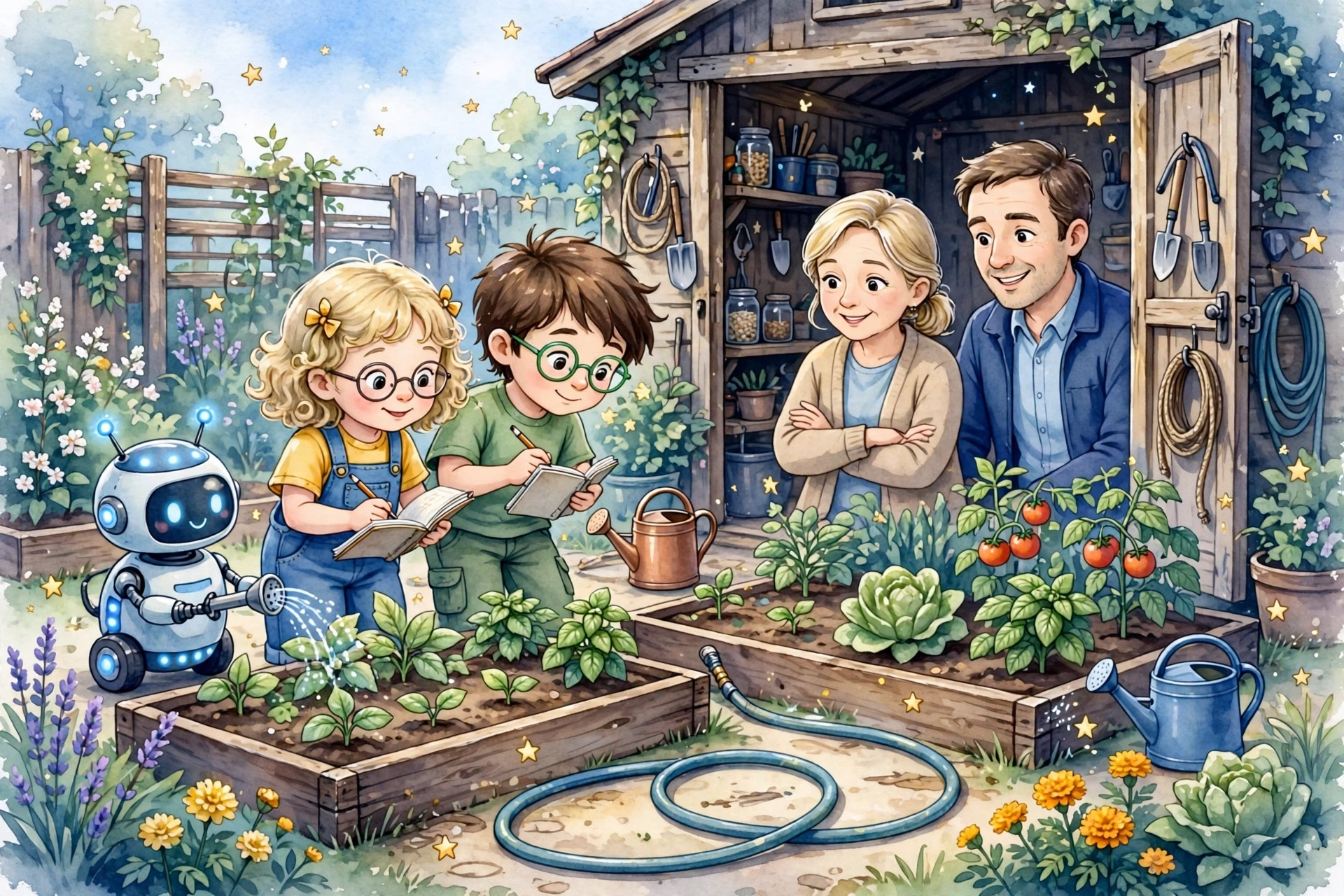
Lina, seven with blonde curly hair and yellow bows, and Umar, eight with brown hair, love Grandma’s garden where tomatoes learn how to grow bigger with help from AI today.
Pip the garden bot waters and watches, and when a plant grows, that information goes back to Pip, and going back to improve is called Feedback Loop.
When tomatoes grow tall, Grandma claps and says “Good job!”, and that good-job clap is a Reward Signal for AI.
When Pip waters too much and leaves turn yellow, that yellow warning is a Penalty, telling AI to try differently.
Pip tries, checks, tries again, and trying again and again is called Iteration.
Each time Pip tries to use less water and more sun, making things better step by step is called Optimization.
Grandpa turns a tiny dial to help Pip water just right, and small careful fixing is called Fine-Tune.
Learning from rewards and penalties over time is called Reinforcement Learning, how AI learns today in games and gardens.
Checking if tomatoes are really taller is called Evaluation, seeing how well learning worked.
Lina says “Pip, more sun!” and that new info makes a fresh Feedback Loop.
Pip gets a big Reward Signal when basil smells strong.
But Pip gets a small Penalty when it forgets to water marigolds.
So Pip starts new Iteration, watering morning and evening.
With each Optimization, plants grow greener.
Grandma helps Fine-Tune Pip’s watering time from five to four minutes.
All this trying is Reinforcement Learning — Pip learns by doing.
Every Sunday they do Evaluation, measuring leaves with a ribbon.
Good gardens use Feedback Loop to listen to plants.
Good AI listens to Reward Signal and avoids Penalty.
With Iteration and Optimization, gardens and AI both get better.
A little Fine-Tune makes a big difference, just like in real AI that helps farmers today.
With Reinforcement Learning and kind Evaluation, Lina, Umar, and Pip grow a garden and grow as a team.
Mom, blonde, and Dad, no beard, watch from the shed and cheer, because learning to grow together is the best harvest of all.
2. Image 1 — Association Anchor (Days 3–4)
Reveal the first image. It anchors what your child already imagined, and introduces the day’s AI vocabulary by pointing to and naming the tech icons in the picture.

3. Meet a Special Word (one per day)
Eight AI pre-literacy words are introduced gradually through simple metaphors — see the table below.
4. Quiz — Did You Catch It?
A short check-in, asked aloud or answered by clicking, to confirm the new word landed.
1. What is Feedback Loop?
2. What is Reward Signal?
3. What is Penalty?
4. What is Iteration?
5. What is Optimization?
6. What is Fine-Tune?
7. What is Reinforcement Learning?
8. What is Evaluation?
5. Image 2 — Creator Prompt (Day 5)
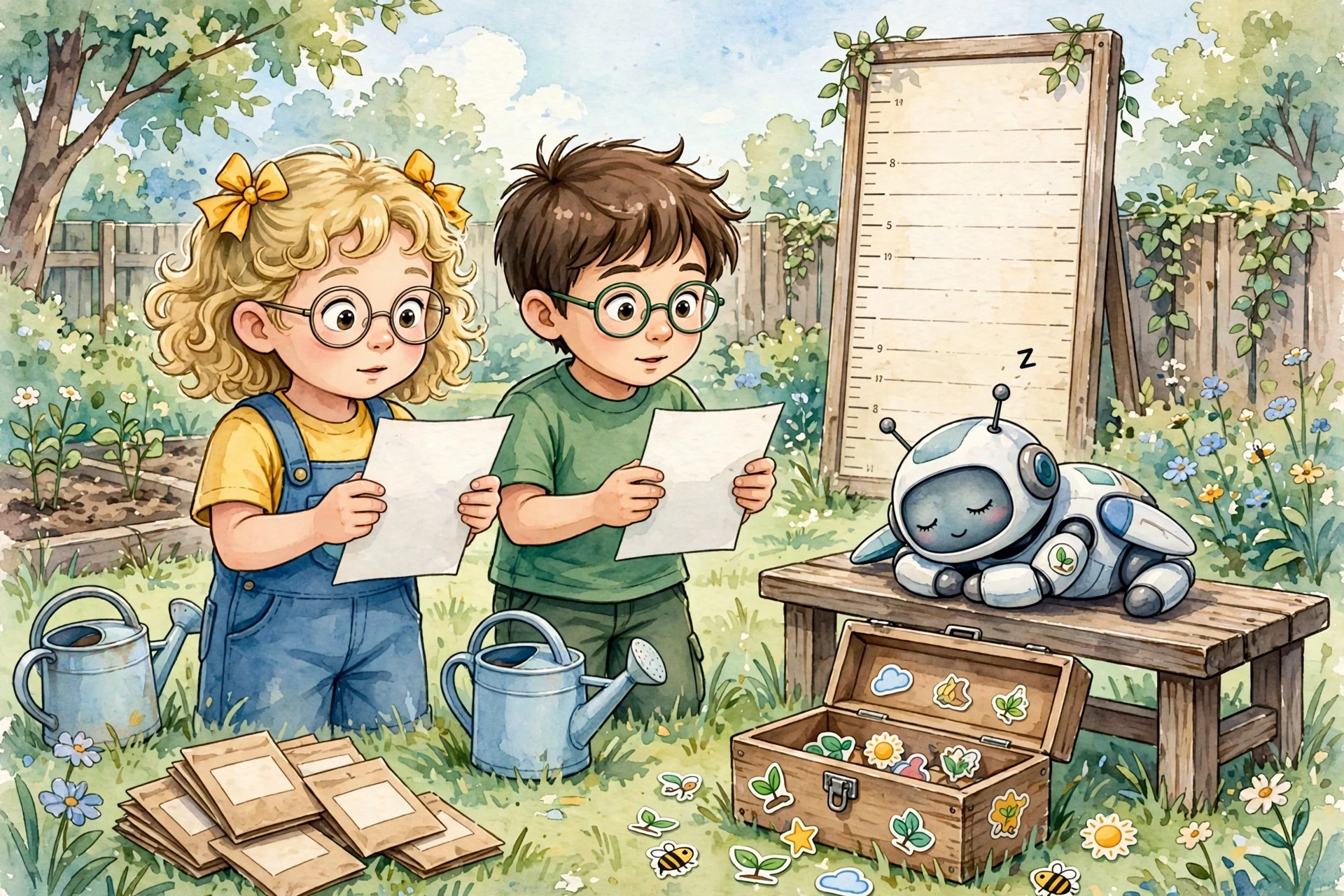
This image never appears in the story text. It’s an open invitation for your child to become the author of something new, using the words they’ve just learned.

6. Bring It Together (Days 6–7)
Your child retells the whole week in their own words — the original story, what they noticed in Image 1, and the new story they invented from Image 2. The family listens and celebrates; there’s nothing to correct. In a classroom, this doubles nicely as a weekly show-and-tell.