
Story 9: The Living Room Premiere
Family Living Room with Parents — 8 AI terms: Object Detection, Segmentation, Depth Estimation, Pose Estimation, Scene Understanding, Visual Search, Emotion Detection, Animation
1. Story (Days 1–2): Read the text with no pictures
Your child becomes the illustrator — ask, “What did you see?”
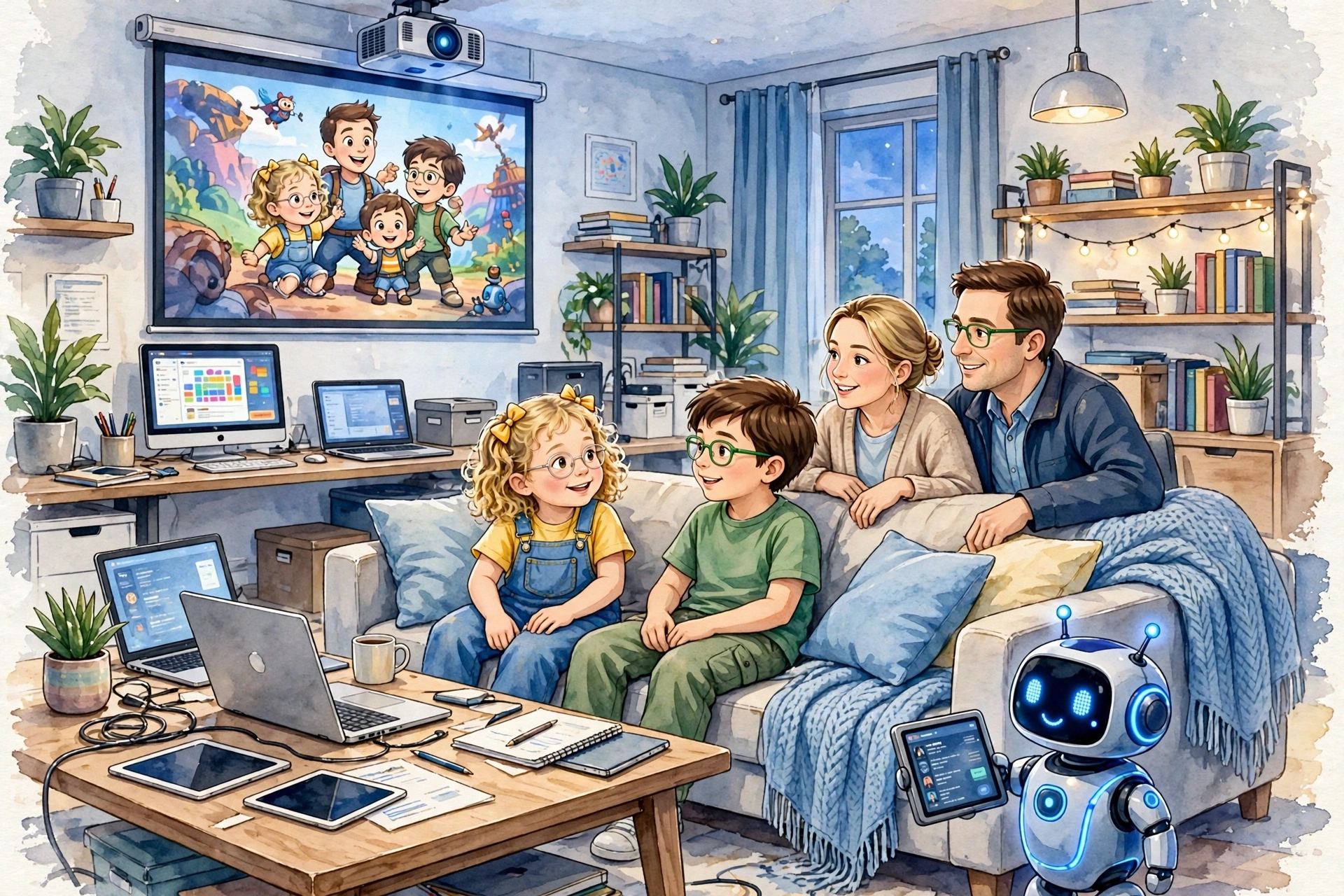
Lina, seven with blonde curly hair and yellow bows, and Umar, eight with brown hair, love the cozy living room where Mom, blonde, and Dad, clean-shaven no beard, watch the family movie with computers, laptops, tablets, and projector today.
The living room has a big projector, laptops open, tablets glowing, and Pip the bot holding a tablet showing pictures.
When Pip finds Lina’s yellow bows in the picture, finding things is called Object Detection.
When Pip colors each person separately, coloring each is called Segmentation.
When Pip knows sofa is close and books far, knowing distance is called Depth Estimation.
When Pip sees Umar standing and Lina sitting, seeing pose is called Pose Estimation.
When Pip understands this is a living room at night, understanding place is called Scene Understanding.
When Lina searches “find our blue blanket,” searching by picture is called Visual Search.
When Pip sees Mom smiling, seeing feeling is called Emotion Detection.
When pictures move like a movie, moving pictures are called Animation.
Lina taps Object Detection — Pip boxes her yellow bows.
Umar tries Segmentation — Pip colors Lina, Umar, Mom, Dad, Pip each different.
Mom asks about distance and Pip does Depth Estimation — sofa close, projector far.
Dad waves and Pip does Pose Estimation — Dad standing, kids sitting.
Pip says with Scene Understanding: “This is cozy family movie night in living room.”
Lina does Visual Search on tablet: “Find the yellow bows picture” — Pip finds it.
Pip does gentle Emotion Detection: “Mom blonde smiles, Dad no beard smiles, kids happy.”
Then Pip makes Animation — their drawing moves on projector.
Good vision AI uses Object Detection and Segmentation to find and color, Depth Estimation and Pose Estimation to know where and how, Scene Understanding to know place, Visual Search to find, Emotion Detection to be kind, and Animation to bring family movie alive.
Lina, Umar, Mom blonde, Dad clean-shaven no beard, and Pip, with one child holding tablet and other holding paper script, in modern living room with computers, laptops, tablets, projector — parents are with the children, celebrating today’s creative co-pilot.
2. Image 1 — Association Anchor (Days 3–4)
Reveal the first image. It anchors what your child already imagined, and introduces the day’s AI vocabulary by pointing to and naming the tech icons in the picture.

3. Meet a Special Word (one per day)
Eight AI pre-literacy words are introduced gradually through simple metaphors — see the table below.
4. Quiz — Did You Catch It?
A short check-in, asked aloud or answered by clicking, to confirm the new word landed.
1. What is Object Detection?
2. What is Segmentation?
3. What is Depth Estimation?
4. What is Pose Estimation?
5. What is Scene Understanding?
6. What is Visual Search?
7. What is Emotion Detection?
8. What is Animation?
5. Image 2 — Creator Prompt (Day 5)
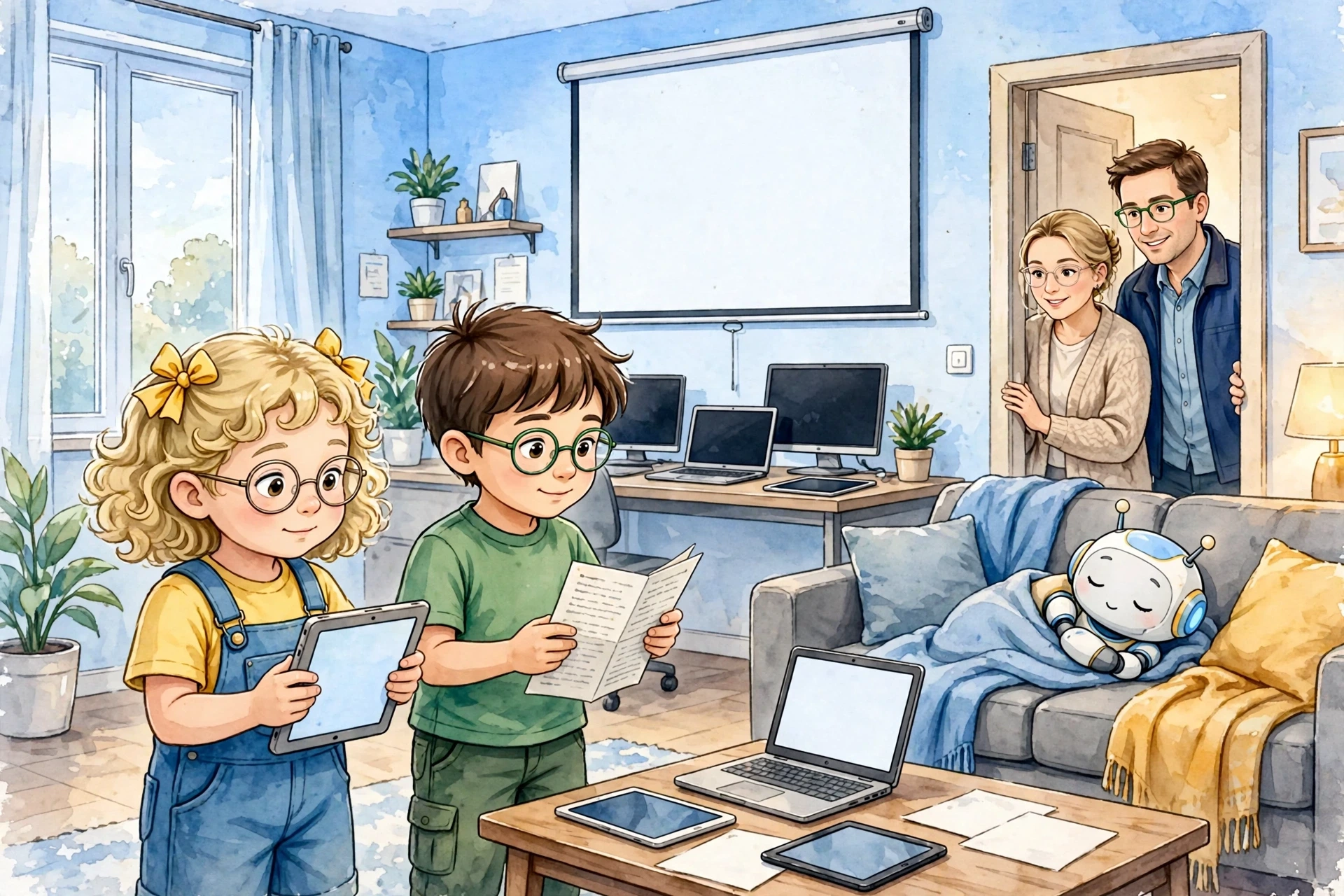
This image never appears in the story text. It’s an open invitation for your child to become the author of something new, using the words they’ve just learned.

6. Bring It Together (Days 6–7)
Your child retells the whole week in their own words — the original story, what they noticed in Image 1, and the new story they invented from Image 2. The family listens and celebrates; there’s nothing to correct. In a classroom, this doubles nicely as a weekly show-and-tell.