
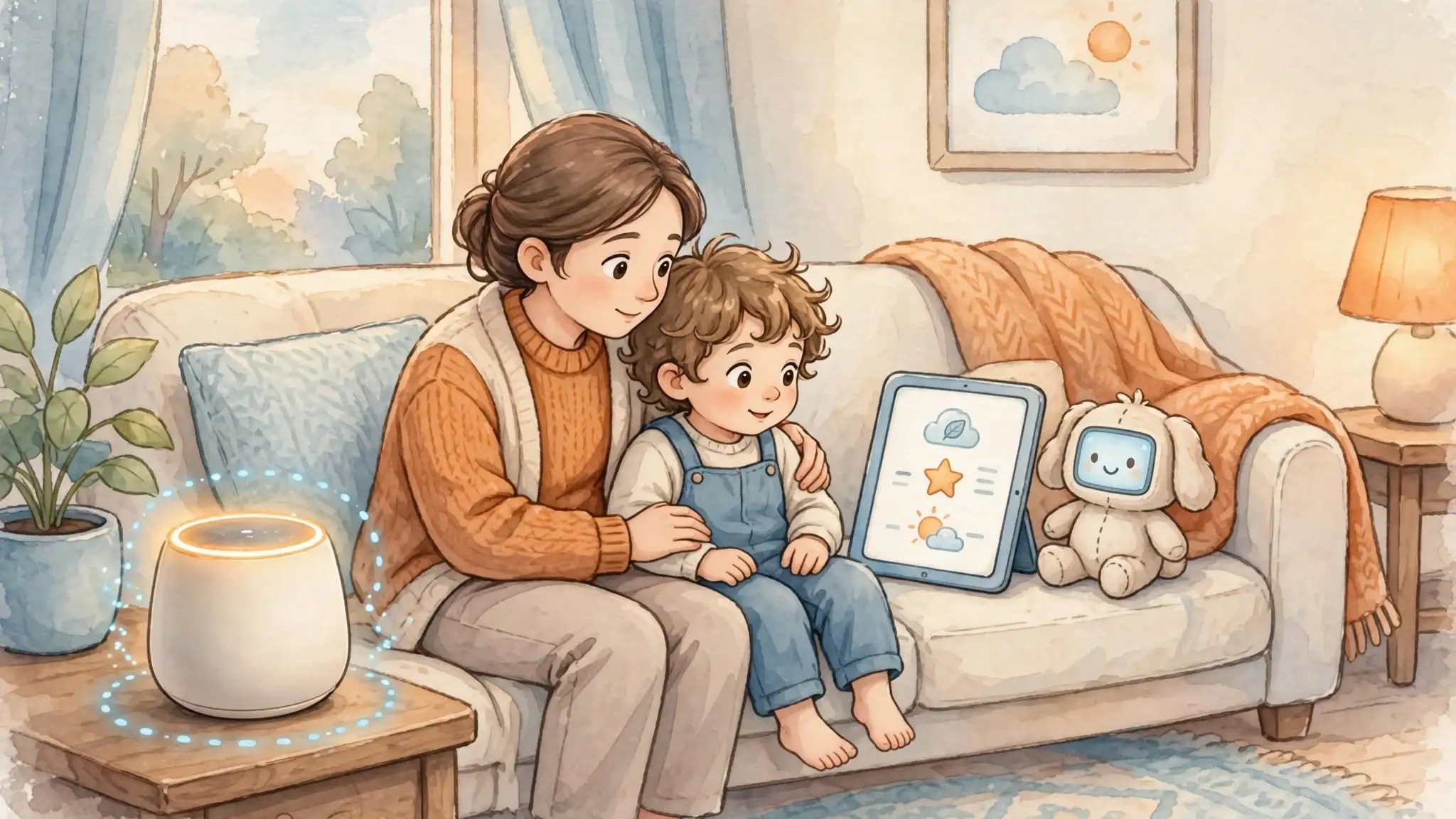
Think for a moment about your child’s day.
Perhaps they woke up and asked a smart speaker to play their favorite song. Perhaps they watched a streaming service that suggested shows “just for them.” Perhaps they played with a talking toy that responded to their voice or used a tablet that seemed to know exactly what they wanted to tap next.
None of these experiences existed for children twenty years ago. Today, they are ordinary.
Your child is already interacting with artificial intelligence—long before they can spell the word “algorithm,” long before they learn to read, and often without anyone ever explaining to them what they are actually interacting with.
This is not a distant future. This is now. And it is happening in your home, in your child’s hands, and often in your pocket.
This post explores just how deeply AI is already embedded in children’s lives — and why helping them understand it is one of the most important conversations parents can have today.
The Problem
Artificial intelligence is not a technology of the future. It is a technology of the present — and it is already woven into the fabric of childhood.
Consider these everyday examples:
- Voice assistants like Alexa, Siri, and Google Assistant are now found in millions of homes. Children as young as three ask them questions, request songs, and give commands — often without understanding that they are speaking to an AI system, not a person.
- Smart toys with AI-powered chatbots are becoming increasingly common. Companies like Curio produce plush toys with built-in voice boxes linked to AI language models calibrated to converse with children as young as three. In China, AI-powered talking companions like “Fuzozo” and “Nailong” are gaining traction, offering emotional companionship, educational content, and even alerts about potential bullying.
- Streaming platforms use recommendation algorithms to suggest videos, shows, and games based on what children have watched before. These algorithms shape what children see, what they learn, and what they want to watch next — often invisibly.
- Video games increasingly incorporate AI opponents, adaptive difficulty, and chatbots that interact with players.
- Tablets and smartphones use AI for facial recognition, voice-to-text, predictive text, and app recommendations.
A 2025 study published in IEEE explored children’s perspectives on AI and found that children as young as 3 to 6 years old already have preconceptions about AI. They understand AI through concretization and anthropomorphization — they view it as an assistant or companion, show awareness of risks, and display strong imagination about what AI is and what it can do. The study concluded that “children are often positioned as passive recipients, rarely granted an active role in AI-related discussions and research,” despite being surrounded by AI technologies from birth.
Another 2025 study, published in the British Educational Research Association journal, used a “draw-a-picture” analysis to explore young children’s preconceptions of AI. The researchers found that everyday technology and media act as the two main sources of young children’s understanding of AI. In other words, children are forming their ideas about AI not from school or from parents, but from the devices and content they encounter daily — often without guidance.
The problem is not that children are using technology too early. The problem is that they are using it without understanding it. They interact with AI systems every day, but they lack the vocabulary, the concepts, and the critical awareness to make sense of these interactions.
As the OECD’s Director for Education and Skills, Andreas Schleicher, has observed, “few education systems prepare students to engage deeply with AI, and to understand how to use AI safely. This gap could leave future generations underprepared for the challenges and opportunities of an even more rapidly changing digital economy and world”.
This gap is not a problem for tomorrow. It is a problem for today — because children are already interacting with AI, whether we are ready or not.
The Solution / Argument
The solution is not to take away the devices or to shield children from technology. That is neither realistic nor desirable. AI is not going away, and it offers enormous opportunities for learning, creativity, and connection.
The solution is to give children the tools to understand what they are interacting with.
This is precisely what AI pre‑literacy offers. It is the foundational stage—typically between the ages of 2 and 7—where the goal is not to teach coding or technical concepts but to build awareness, safe habits, critical thinking, and a healthy relationship with intelligent technologies.
The world’s leading international organizations agree that this matters.
UNESCO, in its AI Competency Framework for Students launched during Digital Learning Week 2024, outlines twelve competencies across four dimensions: a human-centred mindset, ethics of AI, AI techniques and applications, and AI system design. The framework emphasises that students must become “responsible users and co-creators of AI”. Crucially, it recognises that AI literacy begins with understanding — not with coding.
UNICEF, through its AI Strategy 2025–2030 titled “AI for Every Child”, has established a roadmap designed to “ensure AI works in the best interests of children everywhere”. The strategy positions AI not simply as a technological tool, but as “an accelerator for results for children while safeguarding their rights”. It calls for “child-centred AI” and emphasises that “children’s rights, voices and safety” must shape AI governance at every level. UNICEF has also produced the first international-level Policy Guidance on AI for Children, outlining the foundations and specific recommendations for developing child-centred AI.
The OECD and the European Commission, in May 2025, jointly launched a draft AI Literacy Framework for primary and secondary education. The framework outlines 22 competencies across four domains: engage with AI, create with AI, manage AI, and design AI. It defines AI literacy as “the technical knowledge, durable skills, and future-ready attitudes required to thrive in a world influenced by AI”. The framework will provide the foundation for the first assessment of AI Literacy in the OECD’s Programme for International Student Assessment (PISA) in 2029.
These frameworks are not abstract documents. They are a clear signal from the world’s leading education and child-rights organizations that AI literacy is no longer optional. It is essential. And it must begin early.
A 2024 critical review published in Computers and Education: Artificial Intelligence identified 17 AI literacy frameworks across all educational levels, from early childhood to university. The review found that AI literacy is situated at the intersection of digital literacy, data literacy, computational thinking, and AI ethics, emphasizing the need for a transdisciplinary approach that encompasses both technological and societal impacts. However, the study also noted that “AI literacy education mainly targets secondary and university students, often overlooking the unique needs of younger students.”
This is the gap that AI pre‑literacy fills. And it starts with something simple: vocabulary, stories, and conversations.
Evidence / Examples
The research is clear: young children are capable of learning about AI when it is introduced in age-appropriate ways.
A 2024 study published in Interactive Learning Environments involved 26 kindergarten children in Hong Kong in an eight-week AI literacy program. The study found that young children as young as four years old are capable of learning basic AI concepts and knowledge. The intervention significantly improved children’s understanding of AI concepts, their AI-related creativity, and their engagement with the material.
A 2025 study on AI-assisted dialogic reading found that AI-powered storytelling tools can enhance vocabulary development in pre-schoolers, with children exposed to AI-powered storytelling demonstrating stronger vocabulary gains and higher scores in verbal expression and comprehension.
A 2026 study published in IEEE explored fostering AI literacy in early childhood education through STEAM approaches. The researchers found that although children exhibited gains in AI knowledge and skills, their AI attitudes improved modestly — highlighting that “it is imperative to familiarize and cultivate their AI literacy within Early Childhood Education”.
Another 2025 study investigated young children’s understanding of AI through interviews with children aged 3 to 6. The findings revealed four core themes: understanding, functions, relationship, and future of AI. Children understood AI as an assistant and companion, showed awareness of risks, and displayed strong imagination about what AI could be. The study highlighted “the need to construct an AI literacy education and to strengthen educators’ awareness of children’s perspectives alongside their AI-related competencies”.
What all of this research points to is a simple truth: children are ready to learn about AI. They are curious about it, they encounter it daily, and they have ideas about it — even if those ideas are incomplete or based on what they see on screens.
The question is not whether children can learn about AI. The question is whether we are willing to teach them.
Practical Takeaways
Here is what parents can do today — starting right now — to help their child understand the AI already in their pocket:
- Name it. When your child uses a voice assistant, say: “That’s a smart helper. It’s a kind of artificial intelligence — it follows instructions that people gave it.” Use simple, friendly words like smart helper, voice command, and sensor.
- Ask questions. When a streaming service recommends a show, ask: “Why do you think it suggested that? What do you think it knows about what you like?” This builds critical awareness without fear.
- Share the screen. The World Health Organization and the American Academy of Pediatrics both recommend that screen time for young children be shared with a trusted adult. Use that time as an opportunity for conversation, not just consumption.
- Read stories together. Our Tech Tales series introduces AI vocabulary through gentle, engaging stories about Leo and Pip the Smart Helper. Each story is free, ad‑free, and designed to be enjoyed with a grown‑up nearby.
- Follow curiosity. If your child asks why their toy talks back, or how their tablet knows what they want, explore the answer together. You do not need to be a computer scientist. You just need to be curious alongside them.
- Remember the goal. AI pre‑literacy is not about turning your child into a programmer. It is about helping them grow up comfortable, confident, and critical about the technologies that will shape their world.
A Positive Conclusion
Artificial intelligence is already in your child’s pocket. It is in their toys, their screens, and their daily experiences. They are growing up in a world where AI is as ordinary as electricity — and just as invisible.
This does not have to be a source of fear. It can be a source of wonder.
When a child understands that the voice in the smart speaker is following instructions, not thinking like a person, they are learning something profound. They are learning that technology is made by people, for people. They are learning that they can ask questions, that they can be curious, and that they can shape their own relationship with the technologies around them.
UNESCO reminds us that the goal is to prepare young people to be “responsible users and co-creators of AI”. That journey begins not with a keyboard, but with a question. Not with code, but with a story. Not with a screen alone, but with a grown‑up nearby.
That journey begins with a single conversation. And it can start today.
What About You?
Has your child ever asked you about the voice in your smart speaker, or why their tablet seems to know what they like? How did you respond — and what did they say? Share your experience in the comments — we would love to hear how families are navigating these conversations.
About the Authors
Dr. Shaheen Pasha — Retired Professor of Special Education. Ph.D., University of Southampton, UK. Former Chairperson, Department of Special Education, University of Education, Lahore. 35+ research papers, 2 books.
Dr. M. A. Pasha — Retired Professor of Computer Science. Ph.D. in Artificial Intelligence, University of Southampton, UK (1996). Research: AI, Human-Computer Interaction, Computational Thinking. 30+ research papers, 2 books.
Their mission: 70 years of combined academic wisdom, united to foster AI pre‑literacy in young children.
References
- UNESCO. (2024). AI Competency Framework for Students. UNESCO Digital Library.
- UNICEF. (2025). AI Strategy 2025–2030: AI for Every Child. UNICEF.
- UNICEF. (2020). Policy Guidance on AI for Children. United Nations Children’s Fund.
- OECD & European Commission. (2025). Empowering Learners for the Age of AI: An AI Literacy Framework for Primary and Secondary Education (Review Draft).
- Chang, X. (2025). Young children’s understanding of artificial intelligence: A draw‑a‑picture analysis. British Educational Research Journal.
- Children’s Perspectives on Artificial Intelligence. (2025). IEEE Conference Proceedings.
- Su, J., & Yang, W. (2024). Artificial Intelligence (AI) literacy in early childhood education: An intervention study in Hong Kong. Interactive Learning Environments, 32(9).
- Yim, I. H. Y. (2024). A critical review of teaching and learning artificial intelligence (AI) literacy: Developing an intelligence-based AI literacy framework for primary school education. Computers and Education: Artificial Intelligence.
- AI‑assisted dialogic reading at home: enhancing bilingual expressive vocabulary and engagement among Chinese pre‑schoolers. (2025). Taylor & Francis.