
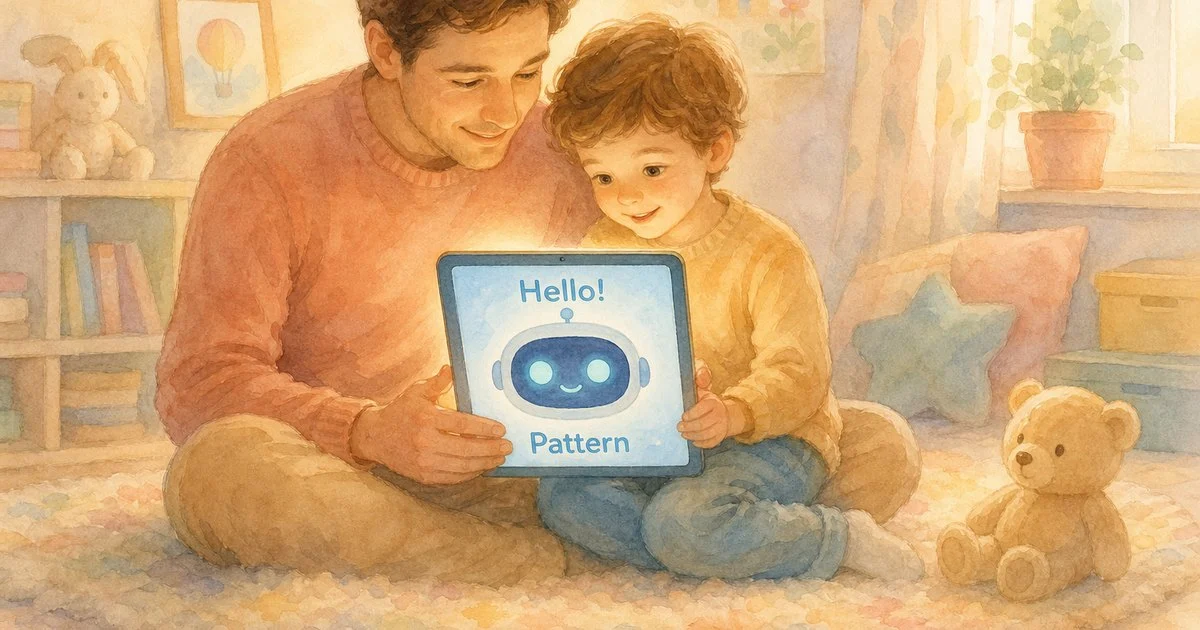
Imagine your five-year-old asking Alexa to play their favourite song. Or swiping through a tablet that recommends shows based on what they watched yesterday. Or chatting with a voice assistant that seems to understand their questions.
Your child is already interacting with artificial intelligence — long before they can spell the word “algorithm”.
Yet most parents have never had a single conversation with their young child about what AI actually is. We teach children to look both ways before crossing the street. We teach them to say “please” and “thank you”. We teach them that strangers can be dangerous. But we rarely teach them that the voice inside the smart speaker is not a person, or that the tablet’s recommendations are not magic — they are the result of patterns, data, and instructions written by people.
This is the gap that AI pre-literacy is designed to fill. And it starts not with coding, but with vocabulary.
The Problem
Most discussions about children and artificial intelligence focus on one of two extremes. On one side, there is panic about screen time and the dangers of technology. On the other, there is a push to teach every child how to code before they reach secondary school.
Both miss the middle ground.
The reality is that AI is already embedded in the everyday environments of young children — in toys, screens, voice assistants, and media content, often in invisible forms. Children encounter AI daily without the language to understand it. They do not know what a “sensor” is, or a “voice command”, or why their tablet seems to know what they want to watch next.
A 2024 study published in the journal Interactive Learning Environments found that young children as young as four years old are capable of learning basic AI concepts and knowledge. The study, which involved 26 kindergarten children in Hong Kong, demonstrated that an eight-week AI literacy program significantly improved children’s understanding of AI concepts, their AI-related creativity, and their engagement with the material.
Yet most education systems are not preparing young children to engage meaningfully with AI. As the OECD notes in its new AI Literacy Framework, “few education systems prepare students to engage deeply with AI, and to understand how to use AI safely. This gap could leave future generations underprepared for the challenges and opportunities of an even more rapidly changing digital economy and world.”
The problem is not that children are using technology too early. The problem is that they are using it without understanding it.
The Solution / Argument
The solution is not to ban screens or to rush children into coding classes. It is something far simpler and more fundamental: AI pre-literacy.
AI pre-literacy is the developmental stage before formal AI literacy curricula begin. It is the period — typically between the ages of 2 and 7 — when the goal is not to teach coding or technical concepts, but to build awareness, safe habits, critical thinking, and a healthy relationship with intelligent technologies.
This is not a fringe idea. In September 2024, UNESCO released its AI Competency Framework for Students, which outlines the knowledge, skills, and values that young people need to become responsible citizens in an AI-driven world. The framework emphasises a human-centred mindset, AI ethics, and the critical evaluation of AI applications.
Similarly, in May 2025, the OECD and the European Commission jointly launched a draft AI Literacy Framework for primary and secondary education. The framework outlines 22 competences across four domains: engage with AI, create with AI, manage AI, and design AI. It is designed to help students understand how AI systems work, critically evaluate their outputs, and use them ethically and creatively.
The OECD has also confirmed that this framework will provide the foundation for the first assessment of AI Literacy in the Programme for International Student Assessment (PISA) in 2029. What is striking about both frameworks is that they begin not with coding, but with understanding. Before a child can create with AI, they must first learn to engage with it. Before they can design AI, they must learn to manage it. And before they can do any of these things, they must learn the vocabulary that makes these concepts accessible.
Evidence / Examples
Consider the World Health Organization’s screen time guidelines. For children aged 2 to 4, the WHO recommends no more than one hour of sedentary screen time per day. For children under 2, screen time is not recommended at all.
The American Academy of Pediatrics offers similar guidance: children ages 2 to 5 should be limited to one hour per day of high-quality, educational, interactive programming.
These guidelines reflect a deep concern about the quality of children’s engagement with screens. But they also create a challenge. If children have only one hour of screen time per day, that time must be intentional. It must be educational. It must build something.
This is precisely what AI pre-literacy offers. When a parent sits with their five-year-old and reads a story about Leo and Pip the Smart Helper, they are not just filling screen time. They are building vocabulary. They are sparking curiosity. They are creating a shared experience that strengthens their bond — and that is precisely what the AAP recommends: “focus on quality, context and conversation.”
Research supports this approach. A 2024 systematic literature review found that AI-powered storytelling can significantly enhance vocabulary acquisition and verbal expression in young children. Another study, published in Education Sciences in August 2024, introduced the “SIACC” framework for early childhood AI literacy, which identifies five core dimensions — Safety, Identity, Attitude, Cognition, and Capability — that young children need to develop in order to engage with AI ethically and appropriately.
The evidence is clear: young children are capable of learning about AI. And they are more likely to do so when the learning is embedded in stories, play, and shared experiences with trusted adults.
Practical Takeaways
Here is what parents can do today to build AI pre-literacy in their young children:
- Start with vocabulary. Words like smart helper, voice command, sensor, battery, correction, touchscreen, algorithm, and cloud are not too complex for a five-year-old — especially when they are introduced through stories.
- Make it a shared experience. The WHO recommends that screen time be balanced with reading and storytelling. Use your child’s screen time as an opportunity for conversation. Ask questions. Wonder together.
- Follow your child’s curiosity. If they ask why their tablet recommended a particular video, explore the idea together. Explain that the tablet is following a pattern — an algorithm — based on what they have watched before.
- Use free, research-informed resources. Our Tech Tales series offers stories, vocabulary guides, and activities designed specifically for children aged 5 to 9 — all free, ad-free, and built to be enjoyed with a grown-up nearby.
- Remember the goal. AI pre-literacy is not about turning your child into a programmer. It is about helping them grow up comfortable, confident, and critical about the technologies that will shape their world.
A Positive Conclusion
We are living in an age of unprecedented technological change. Artificial intelligence is not coming — it is already here. It is in our homes, our schools, and our children’s pockets.
But this does not have to be a source of fear. With the right guidance, it can be a source of wonder.
AI pre-literacy is not about preparing children for a dystopian future. It is about giving them the vocabulary, the curiosity, and the critical thinking skills to navigate that future with confidence. It is about replacing confusion with understanding, and fear with fascination.
As UNESCO reminds us, the goal is to prepare young people to be “responsible users and co-creators of AI.” That journey begins not with a keyboard, but with a question. Not with code, but with a story. Not with a screen alone, but with a grown-up nearby. That journey begins with a single word. And it can start today.
What About You?
Has your child ever asked you a question about the voice in your smart speaker, or why their tablet seems to know what they like? How did you respond? Share your experience in the comments — we would love to hear how families are navigating these conversations.
About the Authors
Dr. Shaheen Pasha — Retired Professor of Special Education. Ph.D., University of Southampton, UK. Former Chairperson, Department of Special Education, University of Education, Lahore. 35+ research papers, 2 books.
Dr. M. A. Pasha — Retired Professor of Computer Science. Ph.D. in Artificial Intelligence, University of Southampton, UK (1996). Research: AI, Human-Computer Interaction, Computational Thinking. 30+ research papers, 2 books.
Their mission: 70 years of combined academic wisdom, united to foster AI pre‑literacy in young children.
References
- UNESCO. (2024). AI Competency Framework for Students. UNESCO Digital Library.
- OECD & European Commission. (2025). Empowering Learners for the Age of AI: An AI Literacy Framework for Primary and Secondary Education (Draft).
- World Health Organization. (2025). Screen Time and Physical Activity Guidelines for Children Aged 1–4 Years.
- American Academy of Pediatrics. (2025). Screen Time Guidelines for Children.
- Yang, W., et al. (2024). Artificial Intelligence (AI) Literacy in Early Childhood Education: An Intervention Study in Hong Kong. Interactive Learning Environments, 32(9), 5494–5508.
- Luo, W., He, H., Gao, M., & Li, H. (2024). Safety, Identity, Attitude, Cognition, and Capability: The ‘SIACC’ Framework of Early Childhood AI Literacy. Education Sciences, 14(8), 871.
- The Role of Artificial Intelligence in Enhancing Early Literacy in Early Childhood Education: A Systematic Literature Review. (2024).