
Not so long ago, being a good digital citizen meant something fairly straightforward: don’t share your password, think before you post, and be kind online.
Those lessons are still important. But they are no longer enough.
Today, digital citizenship must include something far more fundamental: the ability to understand, question, and navigate artificial intelligence. And that journey must begin long before formal AI literacy education starts—in the critical window of ages 2 to 7.
This is the stage we call AI pre‑literacy.
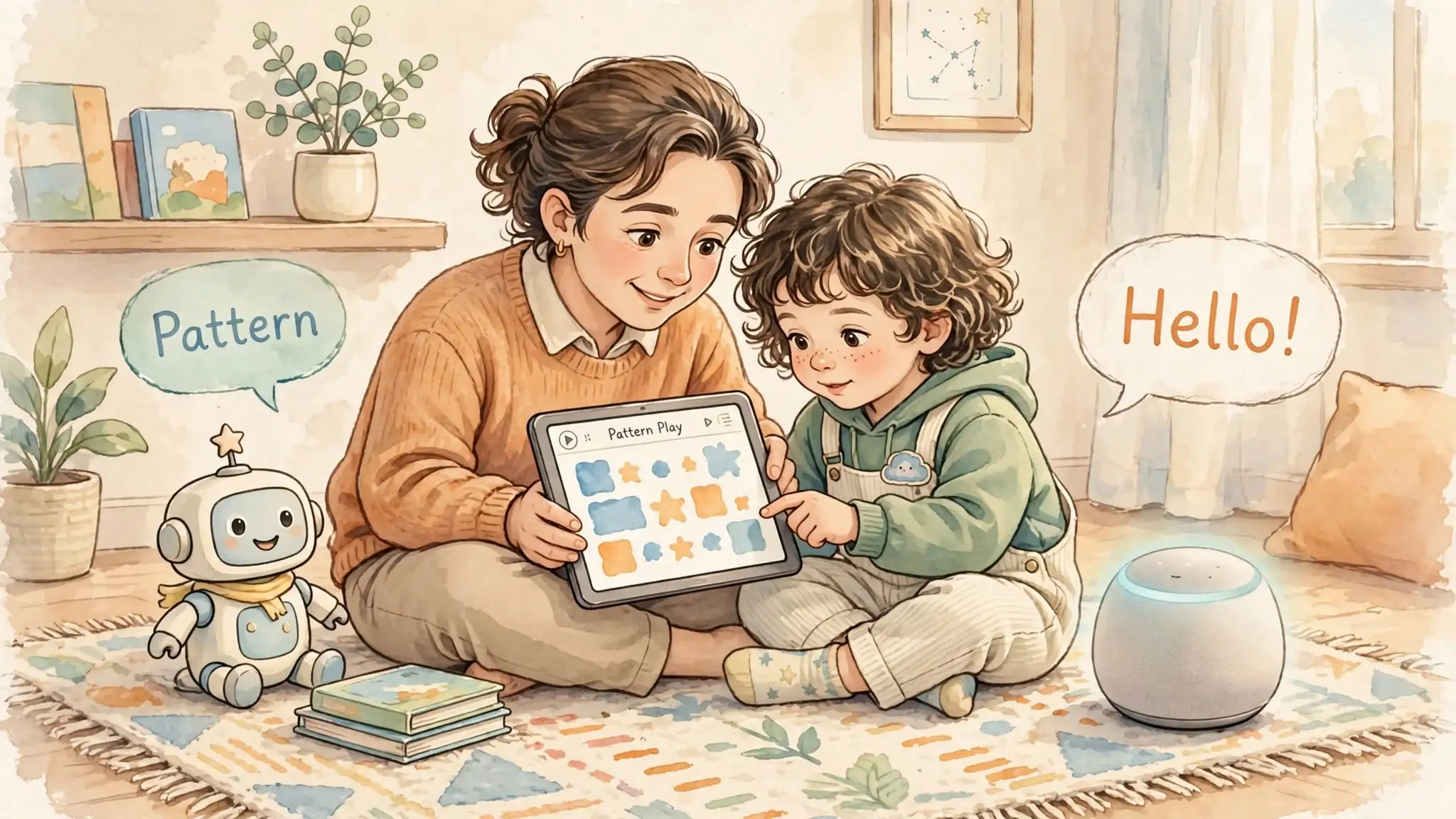
Your child is already interacting with AI every day—through voice assistants, recommendation algorithms, smart toys, and conversational agents. They are forming ideas about what AI is and what it can do, often without any guidance. They are learning to be digital citizens in an AI‑mediated world—whether we are teaching them or not.
Yet the skills-based AI literacy that international frameworks describe is designed for children aged 8 and above. For children aged 2 to 7, the goal is not skill development. It is vocabulary, awareness, safe habits, and critical thinking—the foundational stage that makes later AI literacy possible.
This is why AI pre‑literacy is not a niche concern for tech‑savvy parents. It is the new digital citizenship. And it must begin in early childhood.
The Problem
Digital citizenship education has traditionally focused on online safety, media literacy, and responsible behaviour in digital spaces. These are essential skills. But they were developed for a world where the primary concern was how people use technology, not how technology uses people.
That world no longer exists.
Generative AI and algorithm‑driven platforms are reshaping how children encounter, interpret, and use information. AI systems are not neutral tools—they make decisions, shape recommendations, and influence what children see, learn, and want. Yet most children lack the vocabulary, the concepts, and the critical awareness to understand what they are interacting with.
A 2025 study exploring young children’s understanding of AI found that children as young as three to six years old already have preconceptions about AI. They understand AI through concretization and anthropomorphization—they view it as an assistant or companion, show awareness of risks, and display strong imagination about what AI is and what it can do.
But without guidance, these preconceptions can become misconceptions. Children may believe that AI is a person, that it has feelings, or that it is always right. They may trust recommendations without question. They may share personal information without understanding the consequences.
As the OECD’s Director for Education and Skills, Andreas Schleicher, has warned, “few education systems prepare students to engage deeply with AI, and to understand how to use AI safely. This gap could leave future generations underprepared for the challenges and opportunities of an even more rapidly changing digital economy and world”.
The problem is not that children are using technology too early. The problem is that digital citizenship education has not caught up with the reality of AI — and it has not recognized that the foundational stage for AI awareness must begin in early childhood, long before formal AI literacy education starts at age 8.
The Solution / Argument
The solution is to recognize that AI pre‑literacy is now a core component of digital citizenship—and that it must begin in early childhood, between the ages of 2 and 7.
This is not a replacement for formal AI literacy. It is the foundation upon which AI literacy is built.
The distinction is critical:
- AI Literacy (ages 8+): The technical knowledge, durable skills, and future‑ready attitudes required to thrive in a world influenced by AI. This is where children learn to engage with, create with, manage, and design AI.
- AI Pre‑Literacy (ages 2–7): The developmental stage before formal AI literacy curricula begin. The goal is not to teach coding or technical concepts, but to build awareness, vocabulary, safe habits, critical thinking, and a healthy relationship with intelligent technologies.
The world’s leading international organisations have recognised the importance of both stages — and the critical role of early childhood.
UNESCO, in its AI Competency Framework for Students, describes 12 competencies across four dimensions — including a human‑centred mindset, AI ethics, AI techniques and applications, and AI system design. The framework is designed to prepare learners to become responsible and creative citizens in the AI era. While the competencies are designed for formal education, UNESCO recognizes that the foundation for these competencies—including vocabulary, awareness, and critical thinking—must be built in early childhood.
The OECD and the European Commission, in their joint AI Literacy Framework for Primary and Secondary Education, outline the knowledge, skills and attitudes needed to prepare students to coexist with AI‑based technologies. The framework acknowledges that implementation “for a 5‑year‑old, an 8‑year‑old, and a 15‑year‑old will naturally look very different.” For children aged 5–7, the goal is not technical skill development but foundational awareness.
UNICEF, through its Guidance on AI and Children, emphasizes that AI systems should work in the best interests of children everywhere and that preparing and skilling children for present and future developments in AI is essential. UNICEF also emphasizes that “parents can begin talking about AI when children are quite young, because many kids already encounter AI in their everyday lives.
These frameworks are not abstract documents. They represent a clear consensus: AI awareness is no longer optional—it is a fundamental dimension of digital citizenship, and it must begin in early childhood.
The SIACC framework—Safety, Identity, Attitude, Cognition, and Capability—developed for early childhood AI literacy, explicitly connects early AI awareness to digital citizenship. All seven experts in the study “unanimously pointed out that in the age of AI, young children need to become digital citizens who can understand, apply, and interact with AI”.
The message is unmistakable: AI pre‑literacy and digital citizenship are now inseparable.
Evidence / Examples
The intersection of AI pre‑literacy and digital citizenship is becoming increasingly visible in research and practice.
Media literacy is no longer enough. The rise of generative AI has made it easier to develop deepfakes and other forms of mis‑ or disinformation. Deciphering what is real, what is fake, and everything in between requires an understanding of media literacy—but also an understanding of how AI systems generate content. This understanding must begin in early childhood, with vocabulary and awareness.
Online safety must include AI awareness. Scams and spam have proliferated online with AI. Children need to understand not just how to stay safe online, but how AI systems can be used to manipulate, deceive, and exploit. A 2025 study evaluating critical, digital and AI literacy in primary school education found that little is known about how these complex literacies are being taught in primary school settings—and the study aims to “strengthen digital citizenship, and build resilience against misinformation”. This work must begin before primary school—in the pre‑literacy stage.
Digital citizenship must address the ethical dimension. As the ISTE Student Standards recognize, students need to “exhibit a tolerance for ambiguity, perseverance, and the capacity to work with open‑ended problems.” These dispositions begin to develop in early childhood—through play, conversation, and shared discovery.
The SIACC Framework—Safety, Identity, Attitude, Cognition, and Capability—developed for early childhood AI literacy, explicitly connects AI pre‑literacy to digital citizenship. The framework identifies five dimensions that young children need to develop in order to engage with AI ethically and appropriately—all of which are foundational to digital citizenship.
Play‑based learning works. Research on play‑based interactions with AI robots found that children “exhibited ethical responsibility as active agents, valuing information accuracy and practicing relational ethics of care”. Teachers played a crucial mediating role, “scaffolding interactions and guiding reflection without directing outcomes.” This suggests that early AI education can nurture not just technical understanding, but ethical awareness and responsible digital citizenship—without requiring technical skill development.
Research on early childhood AI awareness confirms that children aged 4–5 can develop foundational AI literacy that integrates technical comprehension, communicative adaptation, and relational ethics through play‑based interactions. A 2024 study concluded that early AI education can “nurture active, reflective, and ethically aware digital citizens”. This is precisely the goal of AI pre‑literacy.
The AI Citizenship Framework, introduced at the IFLA World Library and Information Congress in 2025, presents a five‑tiered progression—Awareness, Familiarity, Literacy, Critical Literacy and Citizenship. The Awareness stage—the first tier—is exactly what AI pre‑literacy provides. It ensures that students become “not merely passive users of AI technologies, but active, responsible, and informed citizens in an increasingly AI‑mediated world.”
The evidence is clear: children are capable of developing AI awareness from a very young age—and when they do, they are better equipped to become responsible digital citizens.
Practical Takeaways
Here is what parents can do today to help their child develop AI pre‑literacy as part of digital citizenship:
- Start with vocabulary. Words like smart helper, voice command, sensor, algorithm, and cloud give children the language to understand what they are interacting with. Without the words, they cannot ask the questions. This is vocabulary building, not skill development—the foundation of AI awareness.
- Teach AI awareness, not skills. For children aged 2–7, the goal is not to teach coding or technical concepts. It is to help children recognise when they are interacting with AI, understand that AI is not a person, and begin to think critically about what AI tells them.
- Discuss safety and privacy. AI systems can fabricate, lose control, or be used to deceive. Teach children not to share personal information with unknown software and to question online requests. Help them build awareness of personal AI security.
- Model critical thinking. When your child uses a voice assistant or watches a recommended show, ask questions: “Why do you think it suggested that?” “How do you think it knows what you like?” “Do you think that’s always right?” This builds critical awareness without fear.
- Make it a shared experience. The World Health Organization and the American Academy of Pediatrics both recommend that screen time for young children be shared with a trusted adult. Use that time as an opportunity for conversation—not just consumption.
- Read stories together. Our Tech Tales series introduces AI vocabulary through gentle, engaging stories about Leo and Pip the Smart Helper. Each story is free, ad‑free, and designed to be enjoyed with a grown‑up nearby—building vocabulary and awareness without technical demands.
- Remember the goal. Digital citizenship in the AI era is not about turning your child into a programmer. For children aged 2–7, it is about helping them grow up as aware, responsible, and informed citizens in an AI‑mediated world—citizens who can understand, question, and shape the technologies that will define their future. The skill development comes later, starting at age 8.
A Positive Conclusion
Digital citizenship has always been about helping children navigate the digital world safely, responsibly, and thoughtfully. But that world has changed.
Artificial intelligence is not a distant technology. It is already embedded in the everyday lives of our children—in voice assistants, smart toys, recommendation algorithms, and conversational agents. It is shaping what they see, what they learn, and what they want.
We cannot prepare children for this world by teaching them the same digital citizenship lessons we learned twenty years ago. We must go deeper—and we must start earlier.
We must give them the vocabulary, the concepts, and the critical awareness to understand not just how to use technology, but how technology uses them. And we must do this before they are ready for formal AI literacy—in the foundational stage of ages 2 to 7.
UNESCO reminds us that the goal is to prepare young people to be “responsible users and co‑creators of AI”. The Council of Europe and Google remind us that AI awareness is now a core component of digital citizenship. The OECD reminds us that AI literacy is essential for future generations—but that it begins with foundational awareness. UNICEF reminds us that AI should work in the best interests of children everywhere.
These are not distant ideals. They are achievable goals. And they begin not with a keyboard, but with a question. Not with code, but with a story. Not with a screen alone, but with a grown‑up nearby.
AI pre‑literacy is the new digital citizenship. And it can start today—with a single conversation.
What About You?
How has your family’s understanding of digital citizenship changed as AI has become more present in your child’s life? What questions have your children asked about the technology they use—and how have you responded? Share your experience in the comments—we would love to hear how families are navigating this new landscape.
About the Authors
Dr. Shaheen Pasha — Retired Professor of Special Education. Ph.D., University of Southampton, UK. Former Chairperson, Department of Special Education, University of Education, Lahore. 35+ research papers, 2 books.
Dr. M. A. Pasha — Retired Professor of Computer Science. Ph.D. in Artificial Intelligence, University of Southampton, UK (1996). Research: AI, Human-Computer Interaction, Computational Thinking. 30+ research papers, 2 books.
Their mission: 70 years of combined academic wisdom, united to foster AI pre‑literacy in young children.
References
- Council of Europe & Google. (2025). Council of Europe – Google partnership to advance digital citizenship education. Council of Europe Newsroom.
- European Commission & OECD. (2025). Empowering Learners for the Age of AI: An AI Literacy Framework for Primary and Secondary Education (Draft).
- Hossain, Z. (2025). AI Citizenship Framework. IFLA World Library and Information Congress 2025, Astana, Kazakhstan.
- ISTE. (2024). Simple Starters for AI Literacy and Digital Citizenship Learning. ISTE Blog.
- Korean Journal of Child Studies. (2026). Emerging Understanding of AI Literacy and Ethics in Young Children: A Qualitative Exploration.
- Luo, W., He, H., Gao, M., & Li, H. (2024). Safety, Identity, Attitude, Cognition, and Capability: The ‘SIACC’ Framework of Early Childhood AI Literacy. Education Sciences, 14(8), 871.
- Oddone, K., et al. (2025). Evaluating Critical, Digital and AI Literacy in Primary School Education. Charles Sturt University Libraries Research Group.
- Play with AI (PL‑AI): A play‑centered, design‑based curriculum for AI literacy in pre‑K and kindergarten. (2026). ScienceDirect.
- UNESCO. (2024). AI Competency Framework for Students. UNESCO Digital Library.
- UNICEF. (2025). Guidance on AI and Children (Version 3.0). UNICEF Innocenti.