AI Pre-Literacy Story 4: The Art Studio That Dreams
School art room — get-well card day · 8 words one per day · AI Pre-Literacy story
1. Story — Text-Based (Day 1-2: Imagination Studio)
Read this AI Pre-Literacy story with NO pictures first. Child becomes illustrator.
The school art room smells of paint and pencil shavings. Long tables. Jam jars of brushes. A high window that shows the top of the school garden.
Lina is six. Omar is seven. They come to the art room on Tuesdays.
At the end of the table sits Pip — the art room’s drawing bot. A small round bot. One camera eye. Two soft ears. A soft blue light.
Today they are making a card. Ms. Ravi the librarian broke her arm. She loves the school garden and the robin that sits on the fence post.
“We will draw her the robin,” says Lina. “On the fence post,” says Omar.
Ms. Adeyemi, the art teacher, fills a jar at the sink. She asks one question. “What does the robin look like?”
“Small,” says Lina. “Red breast. Short tail.”
Pip’s screen glows. “Tell me,” says Pip. “The words you give me are the Prompt.”
Lina leans close. “A robin on a fence post, in a school garden.”
The screen fills with grey snow. It swirls. A blur, then wings, then a small round body, then a red breast.
“That is Diffusion,” says Pip. “I start with noise. I keep smoothing and smoothing until a picture comes.”
The robin sits on a bench. “Close,” says Omar. “Our robin sits on the fence post. Not the bench.”
“I did my best,” says Pip. “Then we do better,” says Lina.
She writes again, more carefully. “A robin on a fence post, small, red breast, short tail, garden behind.”
“That is Prompt Engineering,” says Lina. “Writing careful words so Pip can see what we mean.”
Pip tries again. The robin sits on the fence post. But behind the garden is a big oak tree.
“There is no oak tree in our garden,” says Omar. “Pip made one up,” says Lina. “That is a Hallucination,” says Pip. “I made a thing that is not there. I only know what I have seen before. Most gardens have a tree. So I add one.”
“So your pictures are dreams,” says Lina. “Dreams of everything you have seen. Not dreams of our garden.”
Omar has had enough. “Then I will draw it myself,” he says. He takes a pencil and a piece of paper.
He draws the fence post. He draws the robin. He draws the marigolds and the path. His robin is round. His fence post is crooked. The robin looks a little like a pigeon. “That is not right either,” says Lina. “But it is our garden,” says Omar. “But it looks like a pigeon,” says Lina.
The clock says two-thirty. The card must be done by three. Both versions are wrong.
They sit and look at the paper. Then at Pip’s screen. The garden is right outside the window. The fence post is right there.
“What if we show Pip?” says Lina.
They run out. Lina takes a photo of the fence post, the path, the marigolds. The robin is not there, but everything else is.
They bring the photo back. “Pip,” says Lina. “Use this.”
“A Reference Image,” says Pip. “Now I can see what is real.”
Pip looks at the photo. The screen hums. A picture grows — the real fence post, the real path, the real marigolds, and a robin sitting where the robin sits.
“How many do you want?” says Pip. “I can make eight.” “Eight?” says Omar. “Which one is right?”
“You decide,” says Pip. “That is Curation. You pick the best one from all I make.”
Pip makes eight pictures. Some robins are too fat. Some too thin. One has a blue wing. One is right. “Number seven,” says Lina. “Number seven,” says Omar.
“One more thing,” says Lina. “Can you make it look like a watercolor? Ms. Ravi loves watercolor.”
“That is Style Transfer,” says Pip. “I keep the shapes. I change the paint.” Pip hums. The lines soften. The colors pool at the edges like wet paint.
They print number seven. They glue it to the card. Lina writes the words. Omar draws a small heart in the corner.
Then Pip says one more thing. “I am not Confident about the robin’s tail. Robin tails are short. This one is long. You should check.”
They check. Pip is right. The tail is long. “Can you shorten it?” says Lina.
“Yes,” says Pip. “But now you know. Confidence is how sure I am. Sometimes I am wrong. You are the eyes.”
They fix the tail. The robin sits on the fence post, small and red and right.
That afternoon they take the card to the hospital. Ms. Ravi opens it. She sees the fence post. She sees the path. She sees the robin. No oak tree. No bench. She smiles. Her arm is in a sling. She holds the card with her good hand. “How did you do it?”
“We dreamed it with Pip,” says Lina. “But we showed Pip the real thing first.” “And we checked,” says Omar. “Every picture.”
Pip hums in Lina’s bag, soft and blue. Outside the hospital window, a robin lands on a fence post. He sits exactly where the picture put him — Lina beside the bed, Omar at the foot, Pip glowing low between them.
2. Image 1 — Association Anchor (Day 3-4)
Top of Image 1 — This is what you just read, now you can see it.
3. What is the purpose of this Image 1?
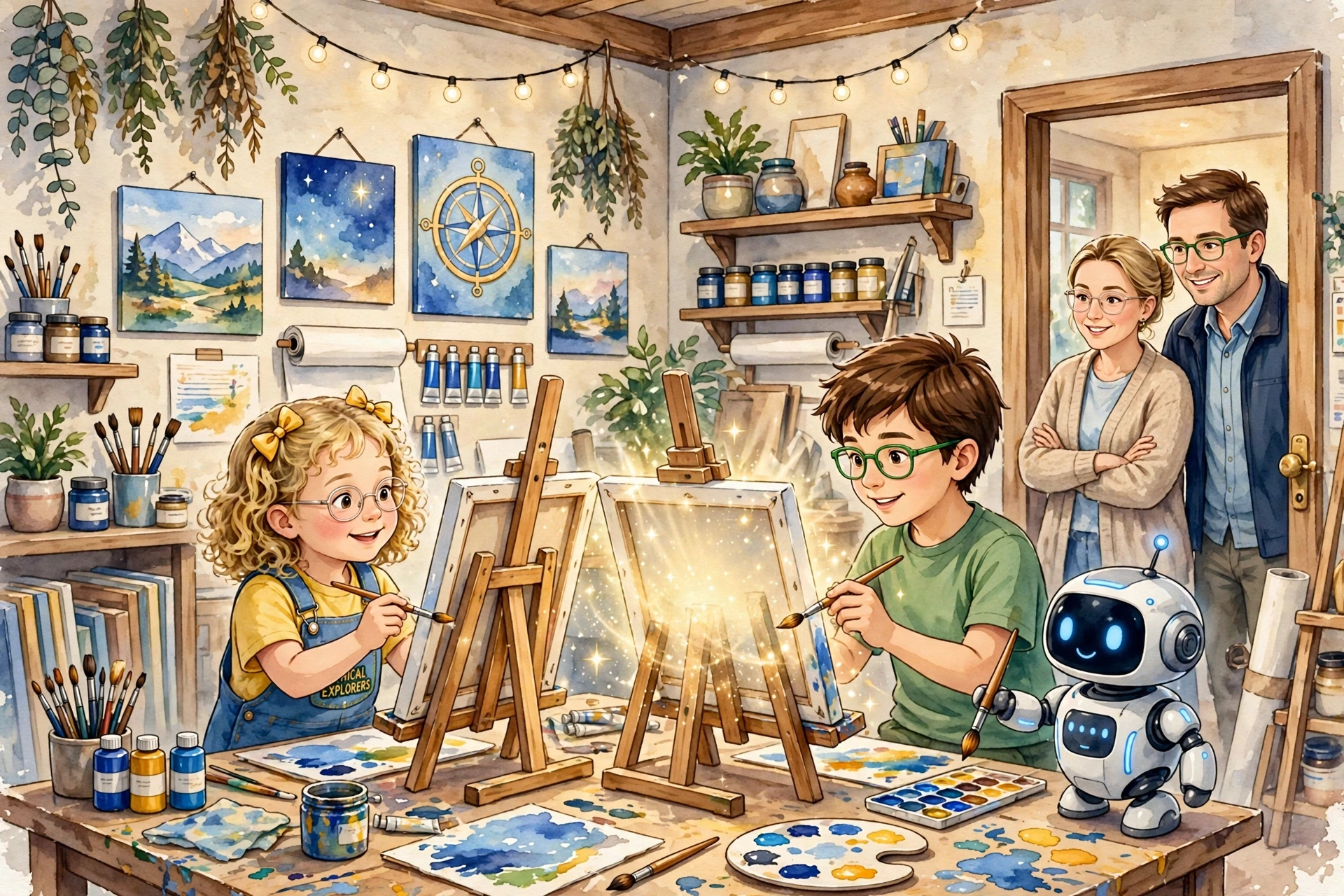
Direct resemblance to this AI Pre-Literacy story — the school art room. On the table: Pip the round drawing bot, one camera eye, two soft ears, screen glowing. On Pip’s screen: a robin perched on a bench, with an invented oak tree behind — the picture Pip made that is almost right but not quite. Lina leans close to Pip’s screen, watching the grey snow turn into wings and a red breast. Omar sits at the far end of the same table with a pencil and a piece of paper, his own robin half-drawn, round and a little crooked. Jam jars of brushes stand between them. Ms. Adeyemi fills a jar at the sink, watching but not stepping in. Through the high window, the top of the school garden is visible — the fence post and the marigolds. The wall clock reads half past two.
Use Day 3-4: Point and name together — Where is Pip’s camera eye? Where are the soft ears? Where is the screen, and what is on it — the bench, or the fence post? Look at the tree behind Pip’s robin. Is that tree in the school garden? Look out the window. What do you see? Where is Lina standing? Where is Omar sitting, and what is he drawing? Where is Ms. Adeyemi, and is she helping? Now look at the clock. The card is due at three. What is the cost of getting it wrong?
4. Meet Your 8 Special Words — One Per Day
AI Pre-Literacy · Story 4 · Tap a card to hear the word
5. Quiz — Did You Catch It?
Story 4 Quiz — tap the answer
1. Which word means: “Starting with noise, and smoothing it until a picture comes”?
2. Which word means: “Writing careful words so the machine can see what you mean”?
3. Which word means: “When a machine makes a thing that is not there”?
4. Which word means: “A picture of the real thing, shown to the machine so it can see what is true”?
5. Which word means: “Picking the best one from all the machine makes — you decide”?
6. Which word means: “Keeping the shapes but changing the paint — the same robin, in watercolor”?
7. Which word means: “The words you give a machine to tell it what to make”?
8. Which word means: “How sure the machine is — and it can be wrong”?
6. Image 2 — Creator Prompt (Day 5: Imagination Studio)
This image is NOT in this AI Pre-Literacy story — this one is YOURS.
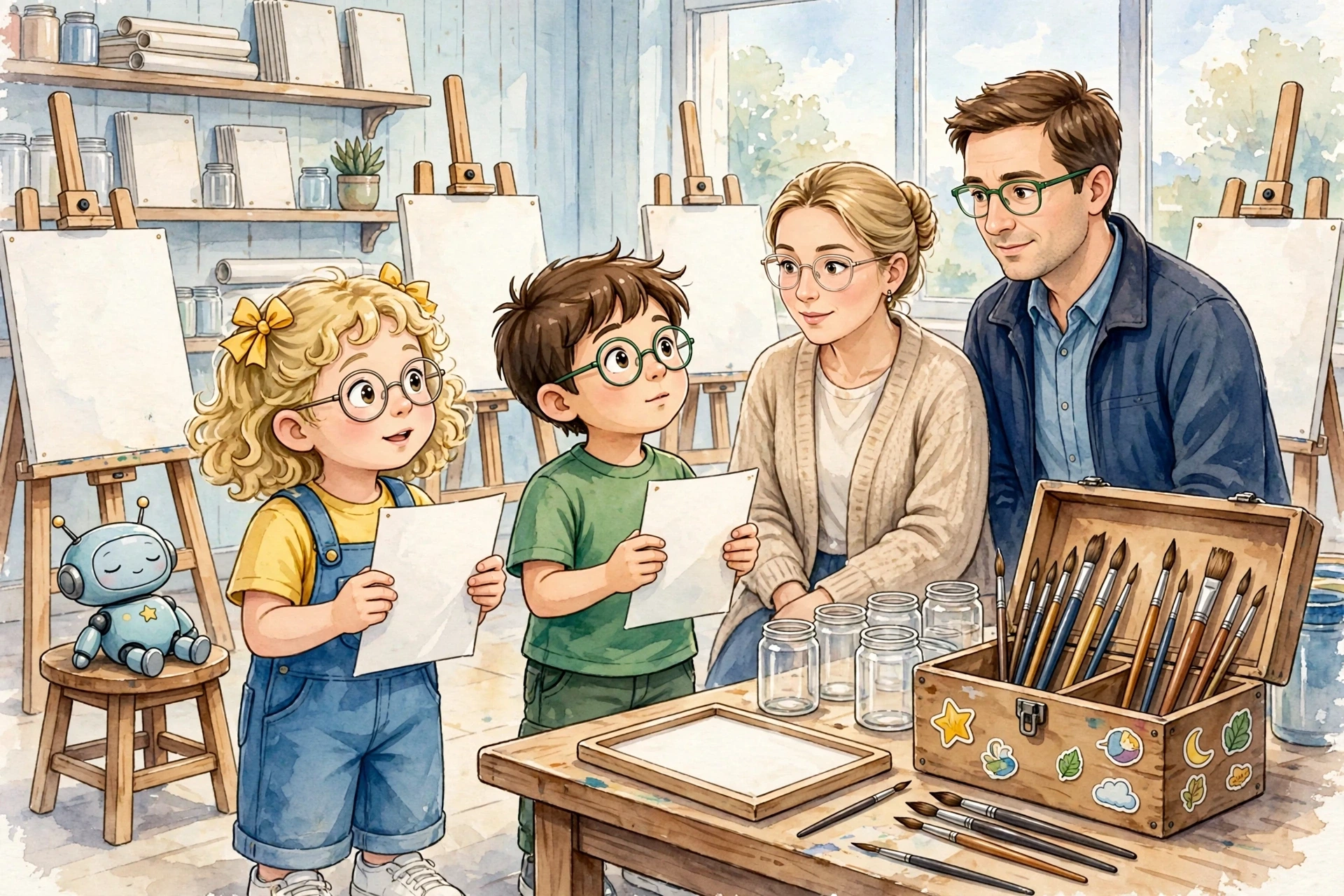
Look at this picture together. You already know Lina and Omar and Pip. You know what happened in the school art room. Now this picture shows you something new — something that did not happen in the story.
Ask your child: Who is in this picture? Where are they? What are they drawing, or building, or fixing? Is Pip here too? What words would YOU give Pip — and what should Pip do if the picture comes out wrong? What is your favourite of the eight? How would you tell Pip to change it?
Let your child tell you the story out loud. Do not correct it. There is no wrong answer.
Then, if they want to, they can draw it.
For Parents & Teachers
Loading…