
AI Pre-Literacy Family Learning Playground
Play together. Think together. Talk together. Grow together.
AI Pre-Literacy Should Never Depend on a Family’s Income
AI literacy frameworks typically begin around age 8 and focus on developing AI skills. The years before that are not a waiting room — they are the prime years. In line with the United Nations Convention on the Rights of the Child — Article 12 (voice), Article 17 (access to media), and General Comment No. 25 (2021) on children’s rights in the digital environment — all 11 games on this page are completely free. No charges, no subscriptions, no sign-up, ever. Every family, every classroom, every community is warmly invited.
What is AI Pre-Literacy?
AI Pre-Literacy is not a simpler version of AI literacy. It is the developmental territory from birth to approximately eight years in which young children encounter, notice, represent, interpret, discuss, orient toward, and respond to artificial intelligence — forming the linguistic, cognitive, affective, empathic, and socio-ethical foundations upon which later AI literacy, critical evaluation, and responsible participation may develop. We take pre in the sense of prime — the first, foremost, formative years. Not the deficit sense of “before.” AI literacy frameworks begin at age eight. AI Pre-Literacy names the prime territory immediately preceding that threshold.
🧩 AI Literacy — from about age 8
Begins from the technology. Asks what AI is, how it works, and what competencies a learner needs to know, use, evaluate, and create it. Its unit of analysis is the learner’s capability. Structured frameworks. Skill development. Delivered through curricula and formal instruction.
🌱 AI Pre-Literacy — the prime years
Begins from the child. Asks how AI has reconfigured the conditions of childhood development itself. Its unit of analysis is the developing person in an AI-woven ecology. No AI tools. No AI skills. No coding. Instead, the human capacities a child will need to live well alongside intelligent machines.
And the AI revolution is not the industrial revolution. Industrial education was built to produce standardized workers for factories — the same pace, the same content, the same output, for everyone. A society shaped by AI needs something different. It needs children who notice patterns, question what is fair, express themselves clearly, and understand real human feeling. Children’s development should match the changing fabric of an AI-driven human society — not the factory model it inherited. The aim is not technical proficiency but developmental sovereignty: children who grow into adults who author with AI rather than being authored by it.
The Five Pillars of AI Pre-Literacy
Not tools. Not skills. Five human capacities built through play.
AI-Related Vocabulary & Linguistic Resources
Imaginative & Cognitive Sense-Making
Attitudes, Perceptions & Epistemic Trust
Emerging Socio-Ethical Awareness
Empathic Attunement & Relational Responsiveness
Family Learning Playground
Play together. Think together. Talk together. Grow together.
Grow your child’s AI foundations.
Where AI pre-literacy begins — in the prime years.
Explore the 12 AI Pre-Literacy Games
Short, playful, screen-light activities that build the five pillars — patterns, sorting, prediction, fairness, feeling, and clear communication.
12 Games · All Free · Ages 3–8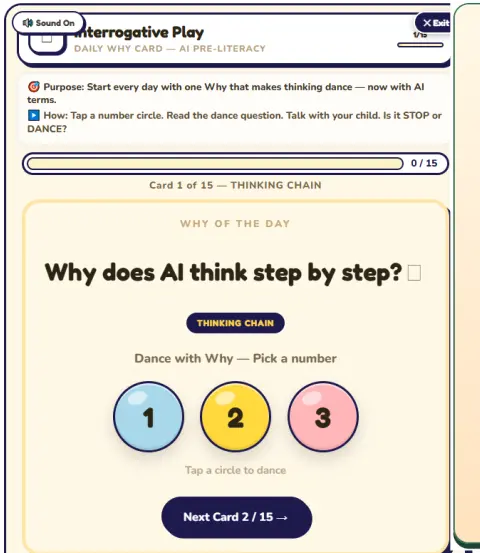
Daily Why Card
👶 Ages 3–8Daily Why Card—Interrogative Play is a 2-minute daily ritual that turns “Why?” from a single answer into a thinking dance.
Play free →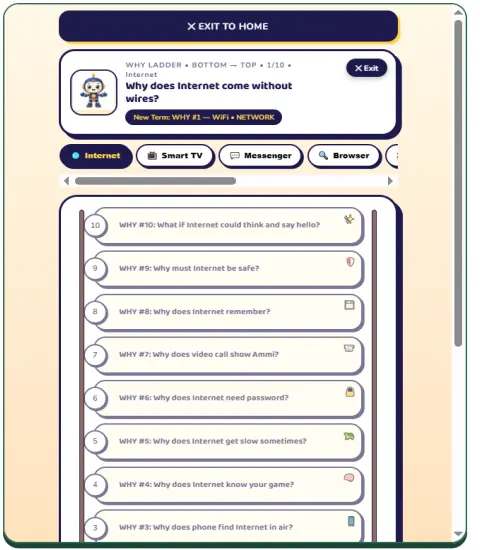
Why Ladder
👶 Ages 3–8This AI preliteracy Why Ladder game is a free critical thinking game that teaches your child not to stop at the first answer from phone or AI. Start with a simple question and then keep asking “Why?” again and again
Play free →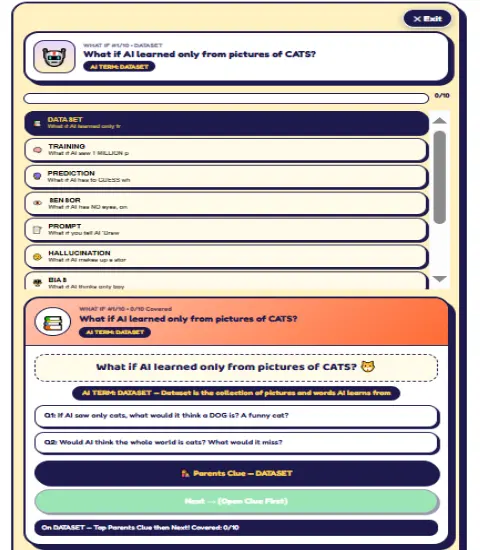
What If Machine
🧒 Ages 3–8This AI pre-literacy game helps children move from “what is” to “what if” — the core of creative thinking and AI literacy. Instead of giving correct answers, children learn to ask wild, funny, impossible questions. That’s how inventors and AI thinkers think!
Play free →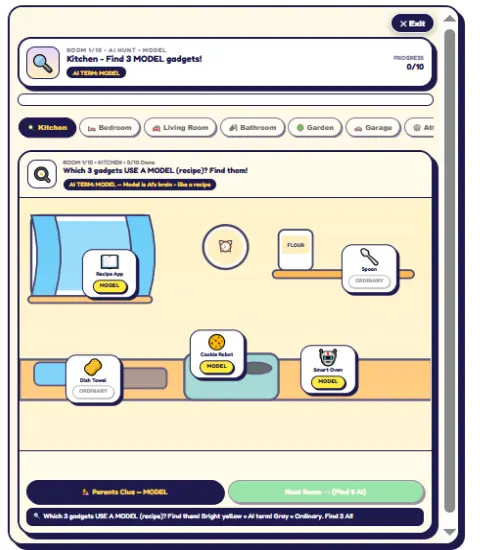
AI Hunt – 10 Rooms
🧒 Ages 3–8AI Hunt is a room-based hidden-object AI pre-literacy game converted from Question Hunt logic, designed for children aged 3-8 to learn AI vocabulary through play.
Play free →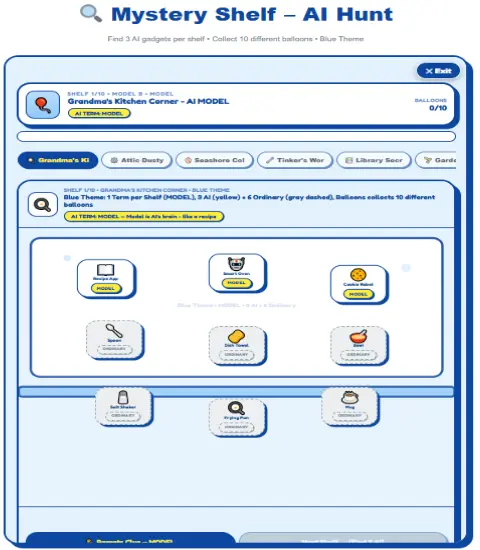
Mystery Shelf – AI Hunt
🧒 Ages 3–8Mystery Shelf trains noticing skill—the first step of Why. Your kitchen, your almirah, your street—all are mystery shelves full of AI and ordinary things.
Play free →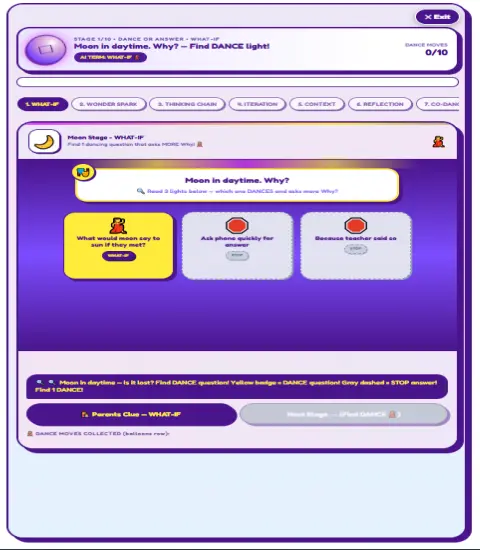
Dance or Answer
🧒 Ages 3–8Dance or Answer is a disco stage AI pre-literacy game where children learn to tell the difference between a STOP answer and a DANCE question.
Play free →
How Game
👶 Ages 3–8How Does AI Work? is the foundational “How it works” workshop for AI Pre-Literacy ages 4-8.
Play free →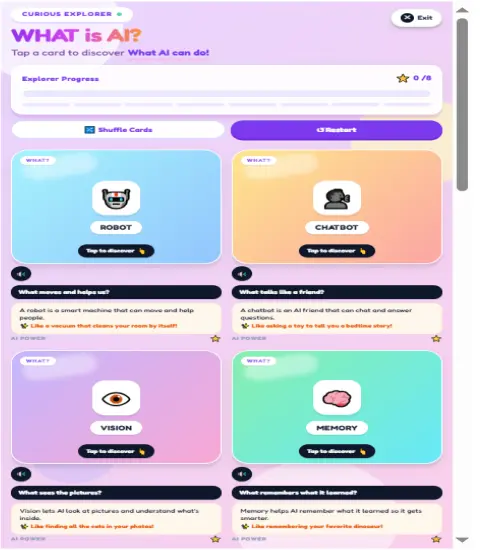
Robot Says
🧒 Ages 3–8Follow step-by-step instructions exactly.How Does AI Work? is the foundational “How it works” workshop for AI Pre-Literacy ages 4-8.
Play free →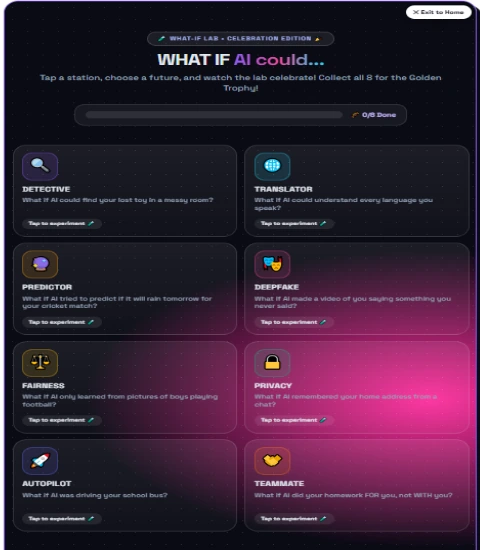
What If Lab
👶 Ages 3–8Welcome to the WHAT-IF Lab! An AI pre-literacy game. A super celebratory space lab where you become an AI scientist. This AI pre-literacy game is for curious explorers aged 3-8 years old.
Play free →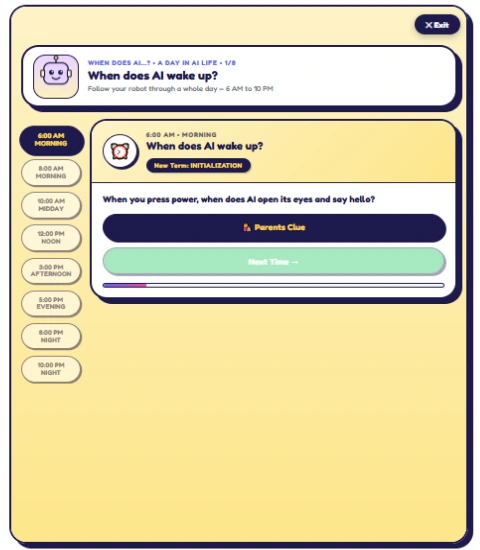
WHAT-IF Lab!
🧒 Ages 3–8Welcome to the WHAT-IF Lab! An AI pre-literacy game. A super celebratory space lab where you become an AI scientist. This AI pre-literacy game is for curious explorers aged 3-8 years old.
Play free →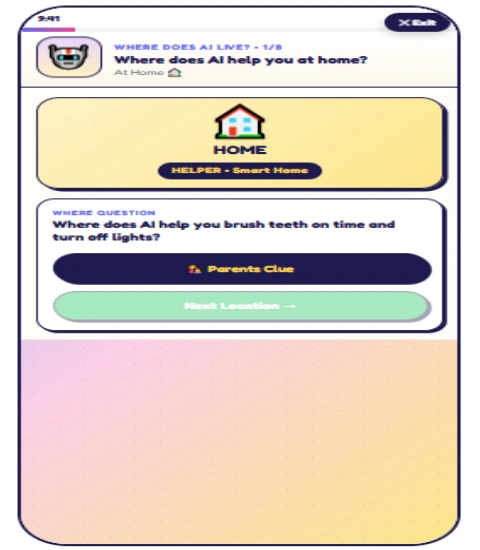
When Does AI
🧒 Ages 3–8This AI pre-literacy game is designed for 3-8-year-old children. In this WHY Session, YOU are the teacher! Robot asks WHY — Why does robot hear sounds? Why does tablet know what I like? Why does robot recognize my face?
Play free →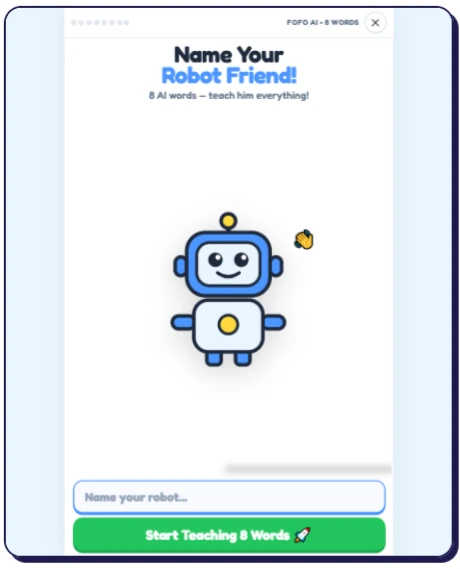
Why Does Robot Hear Sounds?
🧒 Ages 3–8This AI pre-literacy game is designed for 3-8-year-old children. In this WHY Session, YOU are the teacher! Robot asks WHY — Why does robot hear sounds? Why does tablet know what I like? Why does robot recognize my face?
Play free →Always Free
No fees, no subscriptions, no paywalls — so AI pre-literacy is never gated by income.
Pre is Prime
The years before age 8 are not a waiting room. They are the most formative window a child has.
Foundations, Not Tools
No AI tools, no coding, no skill drills — just the five human pillars underneath it all.
Grown-Up Friendly
No technical knowledge needed — just sit, talk, and play together.