
Story 8: The Ship That Knows the Way
Ship with AI Watches — 8 AI terms: Wearable AI, GPS, Geofencing, Wayfinding, Compass, Sonar, Autonomous Navigation, Haptic Feedback
1. Story (Days 1–2): Read the text with no pictures
Your child becomes the illustrator — ask, “What did you see?”
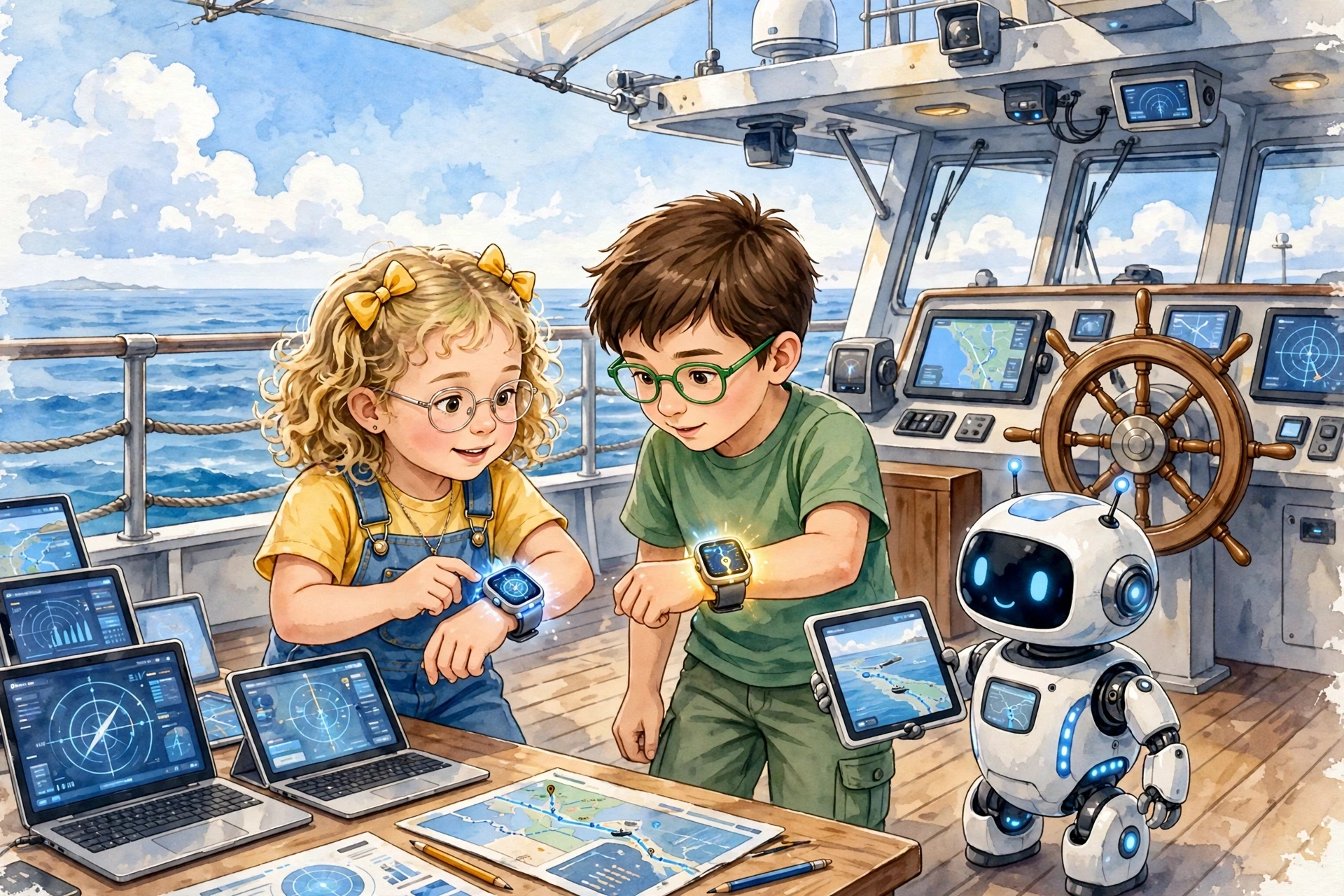
Lina, seven with blonde curly hair and yellow bows, and Umar, eight with brown hair, love sailing on a bright ship where computers, laptops, tablets, and glowing watches help navigate the sea today.
Lina and Umar wear special AI watches on their wrists, and smart AI on your wrist is called Wearable AI.
When watch says “You are here in the ocean,” knowing where you are is called GPS, which means Global Positioning System.
When watch buzzes if you go too far from safe area, safe invisible fence is called Geofencing.
Finding your way from island to island is called Wayfinding.
The little arrow that always points north is called Compass, now inside the watch.
Listening to sea echoes to find depth is called Sonar.
When ship steers itself safely with help, self-steering is called Autonomous Navigation.
When watch buzzes your wrist to tell you turn, feeling buzz is called Haptic Feedback.
Lina taps her Wearable AI watch and it glows blue with a map.
Umar checks GPS — dot shows their ship near Coral Island.
Their watches do Geofencing — buzz if they drift outside safe sailing zone.
Together they practice Wayfinding from Blue Bay to Star Island.
Pip shows Compass inside watch pointing north, even when cloudy.
Pip pings Sonar — beep-beep shows shallow water ahead.
The ship uses Autonomous Navigation to stay on course, with Umar watching.
And when to turn left, watches give gentle Haptic Feedback buzz on wrist.
Lina on AI watch, Umar on computer and tablet on ship table, one holding tablet, one holding paper map — no parents, just two kids and Pip, navigating today’s ocean with computers, laptops, tablets, and glowing AI watches.
Good navigation AI uses Wearable AI and GPS to know where, Geofencing to stay safe, Wayfinding and Compass to find way, Sonar to hear sea, Autonomous Navigation to help steer, and Haptic Feedback to feel directions on your wrist.
2. Image 1 — Association Anchor (Days 3–4)
Reveal the first image. It anchors what your child already imagined, and introduces the day’s AI vocabulary by pointing to and naming the tech icons in the picture.

3. Meet a Special Word (one per day)
Eight AI pre-literacy words are introduced gradually through simple metaphors — see the table below.
4. Quiz — Did You Catch It?
A short check-in, asked aloud or answered by clicking, to confirm the new word landed.
1. What is Wearable AI?
2. What is GPS?
3. What is Geofencing?
4. What is Wayfinding?
5. What is Compass?
6. What is Sonar?
7. What is Autonomous Navigation?
8. What is Haptic Feedback?
5. Image 2 — Creator Prompt (Day 5)
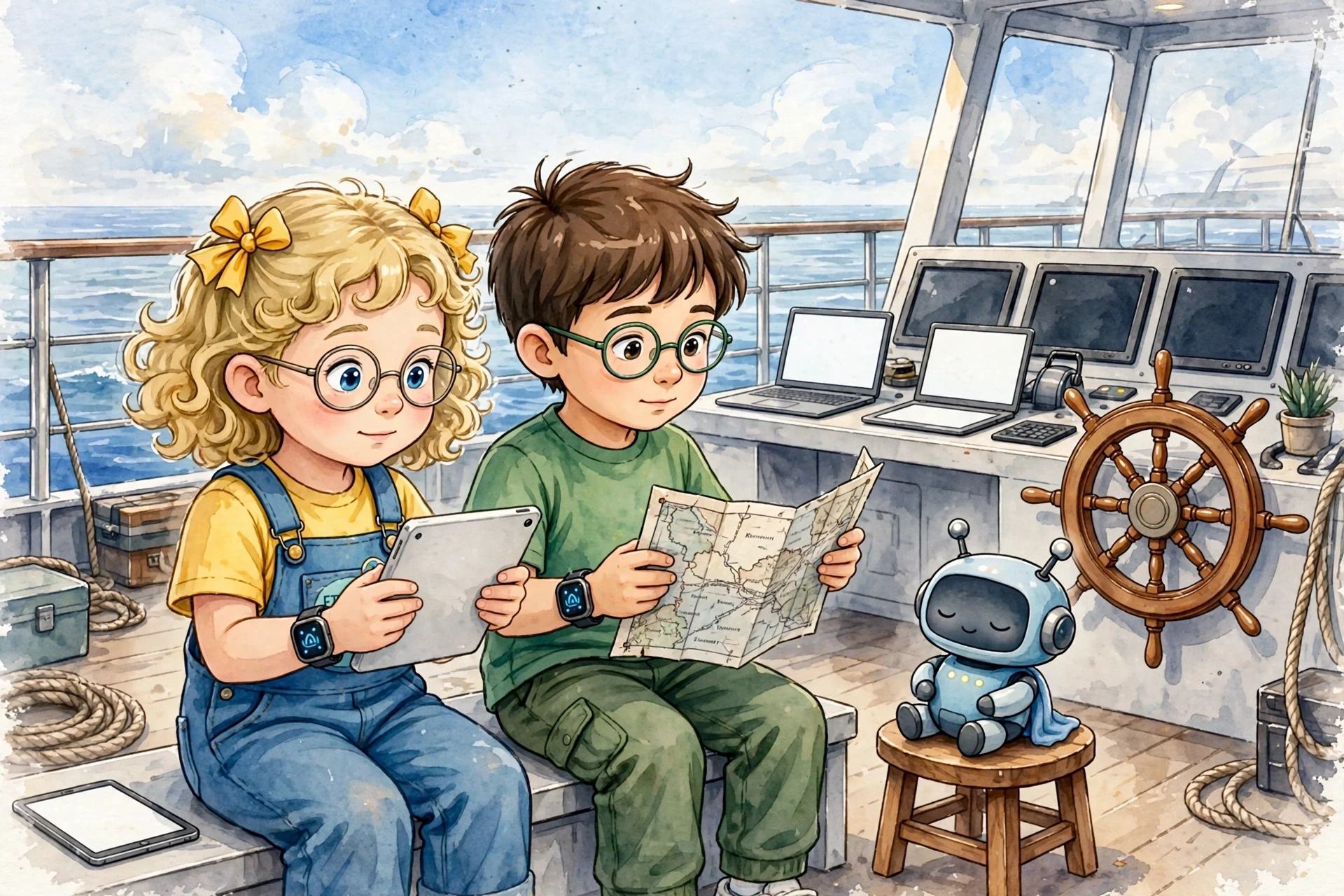
This image never appears in the story text. It’s an open invitation for your child to become the author of something new, using the words they’ve just learned.

6. Bring It Together (Days 6–7)
Your child retells the whole week in their own words — the original story, what they noticed in Image 1, and the new story they invented from Image 2. The family listens and celebrates; there’s nothing to correct. In a classroom, this doubles nicely as a weekly show-and-tell.