
AI Pre-Literacy Story 5: The Laundry That Sorts Itself
Home laundry room — the washer that sorts · 10 words · AI Pre-Literacy story
1. Story — Text-Based (Day 1-2: Imagination Studio)
Read this AI Pre-Literacy story with NO pictures first. Child becomes illustrator.
The laundry room is small and warm. It is Saturday. Lina is seven. Omar is eight. Pip stands by the door, tall and humanoid, blue light soft at the eyes.
The washer has a wide screen on the front. Inside the drum, three small cameras look at the clothes. A scale under the drum weighs them.
“Whites on the left. Colours on the right. Delicates in the small drum,” says the screen.
That is Classification — putting things into groups by what they share.
The washer learned from examples. Last winter, Dad fed it pictures. A hundred white shirts. A hundred dark jumpers. A hundred towels.
That is Training Data — the examples the machine learns from.
From each picture, the machine pulls out three things. Colour. Weave. Weight. That is Feature Extraction — pulling out the few things that matter.
Lina lifts the lid of the basket. The basket is heavy. There is a whole week of clothes.
“One big load,” says Lina. “Save time.”
“Small loads,” says Omar. “So we can see.”
“You always say small.” “You always say big.” Neither one smiles. Pip watches both of them.
Dad is upstairs. Grandpa is in the garden. They load the drum together — half a basket each.
The washer weighs the load. 6.4 kilograms. The drum spins slow. The cameras look at each one.
Shirt. Sock. Towel. Jumper. Pillowcase. It names them on the screen. That is Classification again.
There is one last thing in the basket. A pale-yellow jumper. Fine weave. Very light. Mom’s, from when she was a girl.
Lina puts the jumper in.
The washer looks at it. The screen goes quiet. Then it says one word: “White.”
“It’s yellow,” says Omar. “Pale yellow.”
“Pale enough,” says Lina. The lid closes. The drum turns.
Forty minutes later, the lid opens. Steam in the air.
The shirt is white. The socks are white. The towel is white. The pillowcase is white.
The jumper is grey. A soft, even grey. All over. The yellow is gone.
Lina holds it up. Omar holds it up. Neither one speaks.
“It was white,” says the washer. “The colour faded.”
“It was yellow,” says Omar. “Pale yellow. It has always been pale yellow.”
Dad comes down. He sees the jumper. He sits on the stool. “Mom’s jumper,” he says.
Nobody is angry. The room is very still. That is the cost. Some things cannot be undone.
Pip looks at the screen. “Show me the training data.”
The screen shows the pictures Dad fed in. A hundred white shirts. A hundred dark jumpers. A hundred towels.
“There are no pale-yellow jumpers in the training,” says Pip. “Not one. And every picture has a Label — a name. ‘White.’ ‘Dark.’ ‘Towel.'”
“So the machine had only two boxes,” says Omar. “White, or dark. The jumper is neither.”
“And it went in the wrong box,” says Lina.
That is Misclassification — putting something in the wrong group. The machine said white. The true colour was pale yellow. That is a False Positive — the machine saying yes to a thing that is not so.
“Why white, and not dark?” says Omar.
“Because the white examples are many, and the pale jumper is close to them,” says Pip. “One box is much bigger than the other. That is Class Imbalance.”
“And the machine wanted to be right. It learned the examples so well that a pale new thing was called white. That is Overfitting — learning the training too well, and missing the new.”
“Could it have said ‘I don’t know’?” says Lina.
“Not yet,” says Pip. “Saying ‘I am not sure’ is Generalization — doing well on things I have never seen. It comes after training. Not before.”
Dad brings a box from the attic. Old clothes of every shade. Soft greys. Faded roses. Washed-out blues. They photograph them. They label each one. “Pale.” “Faded.” Not white. Not dark.
“And if it gets another one wrong?” says Omar.
“Then we look again,” says Pip. “We go back to the training data. That is Error Analysis — going back to see where the machine went wrong.”
Mom comes home. She sees the grey jumper folded on the table. She sits. She holds it.
Lina holds the photo of the grey jumper. Omar holds the new label card in his hand. And Pip stands between them, tall and steady, blue light soft, with the machine learning one pale thing at a time.
2. Image 1 — Association Anchor (Day 3-4)
Top of Image 1 — This is what you just read, now you can see it.
3. What is the purpose of this Image 1?
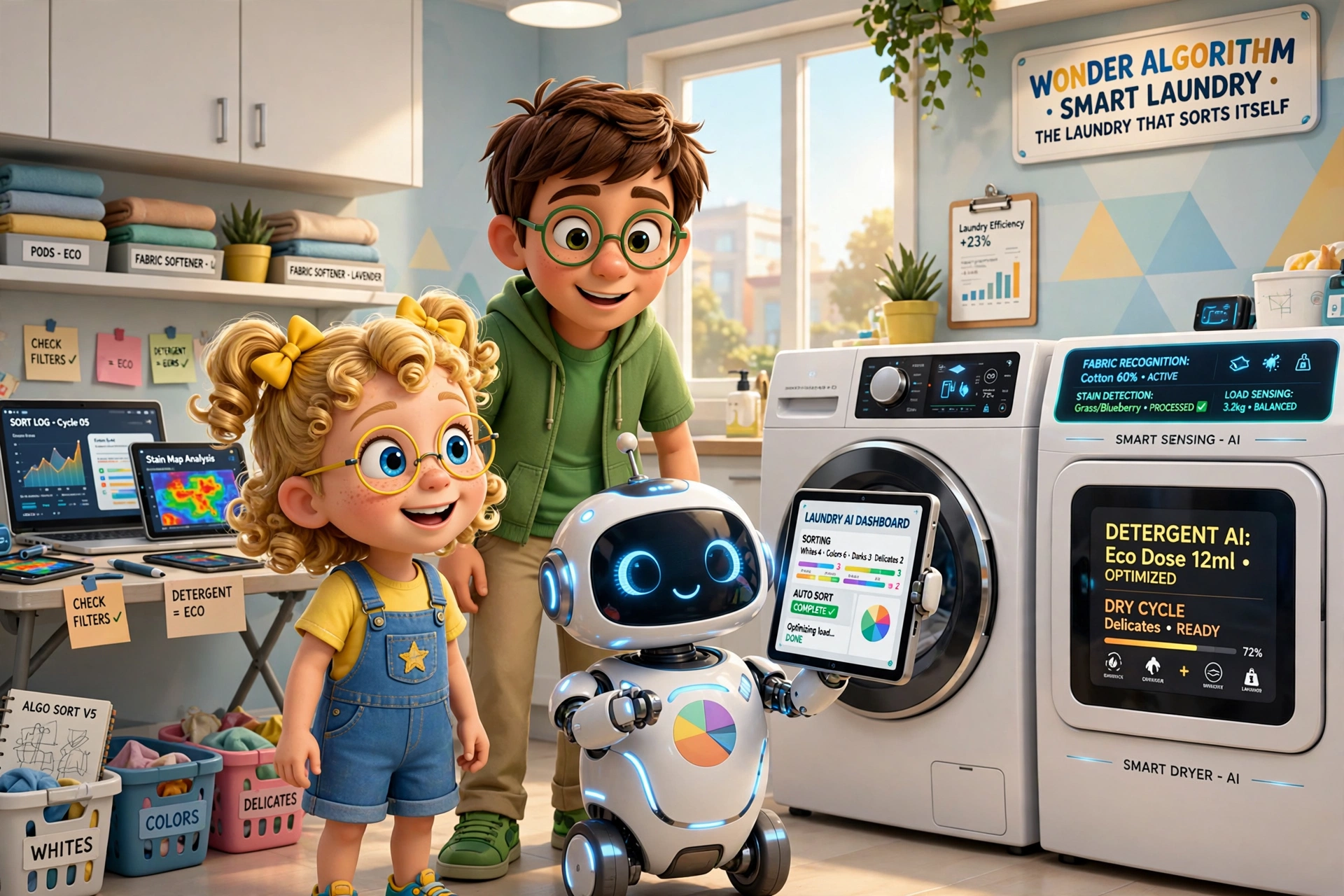
Direct resemblance to this AI Pre-Literacy story — the home laundry room at the moment the washer says the wrong word. The washer door stands open. On its wide glowing screen, one word in copper: WHITE. On top of the load, the pale-yellow jumper with the fine weave sits bright against the whites — the machine has just called it white. Lina — age seven, blue overalls, yellow shirt, round glasses — stands close to the drum with one hand on the door. Omar — age eight, green shirt, green glasses — stands back a step with his arms folded. Pip stands by the door frame, head turned toward the screen. Dad has just sat down on the stool. On the low shelf by the window: the wicker basket, a paper tag with three blank lines, and the small scale under the drum showing 6.4 kg.
Use Day 3-4: Point and name together — Where is the word WHITE on the screen? Where is the pale-yellow jumper — under the whites, or on top? Where are the three small cameras inside the drum? Where is the scale, and what number does it show? Where is Lina standing — close or far? Where is Omar standing — close or far? Who is folding their arms, and who has one hand on the door? Where is Pip? Where is the paper tag, and how many blank lines does it have? Now look at the jumper again. What does the machine think it is? What is it actually?
4. Meet Your 10 Special Words — One Per Day
AI Pre-Literacy · Story 5 · Tap a card to hear the word
5. Quiz — Did You Catch It?
Story 5 Quiz — tap the answer
1. Which word means: “Putting things into groups by what they share”?
2. Which word means: “The examples the machine learns from”?
3. Which word means: “Pulling out the few things that matter”?
4. Which word means: “A name given to a training example”?
5. Which word means: “Putting something in the wrong group”?
6. Which word means: “One group has many more examples than another”?
7. Which word means: “The machine saying yes to a thing that is not so”?
8. Which word means: “Learning the training too well — and missing the new thing in front of it”?
9. Which word means: “Doing well on things I have never seen — it comes after training, not before”?
10. Which word means: “Going back to see where the machine went wrong — and why”?
6. Image 2 — Creator Prompt (Day 5: Imagination Studio)
This image is NOT in this AI Pre-Literacy story — this one is YOURS.
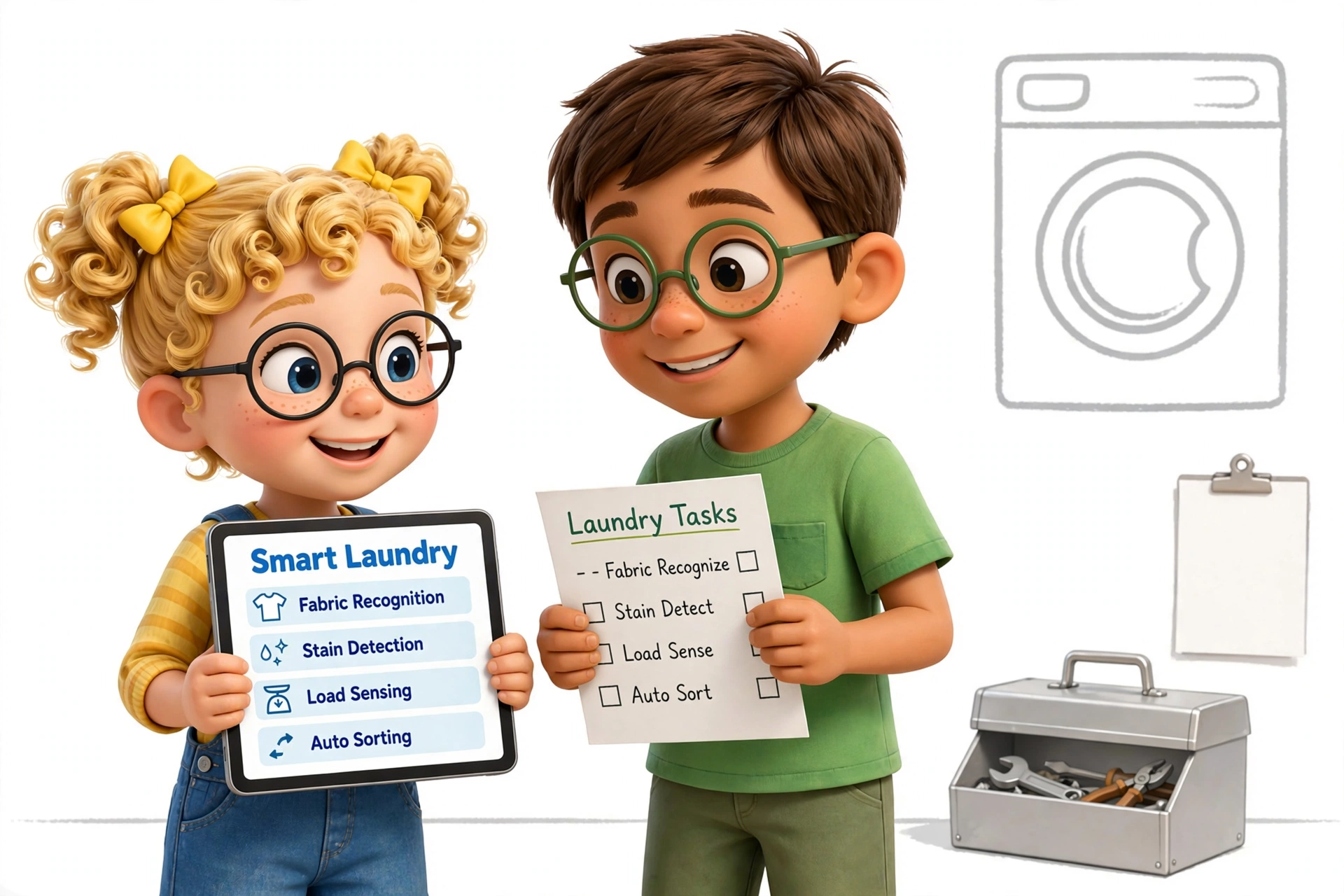
Look at this picture together. You already know Lina and Omar and Pip. You know what happened in the laundry room. Now this picture shows you something new — something that did not happen in the story.
Ask your child: Who is in this picture? Where are they? What is the third box on the wall — PALE — and what should go inside it? What other boxes would you add — soft greys, faded roses, washed-out blues? Who decides what goes in each box — the machine, or a person? If the machine is not sure what a jumper is, what should it do? What should it say? If it must stop and ask, who does it ask?
Let your child tell you the story out loud. Do not correct it. There is no wrong answer.
Then, if they want to, they can draw it.
For Parents & Teachers
Loading…