
AI Pre-Literacy Story 6: The Garden That Waters Itself
Grandpa’s allotment — the garden that waters itself · 10 words · AI Pre-Literacy story
1. Story — Text-Based (Day 1-2: Imagination Studio)
Read this AI Pre-Literacy story with NO pictures first. Child becomes illustrator.
Grandpa’s garden sits at the back of the allotments, past the raspberry canes. Lina is seven. Omar is eight. Pip walks beside them, tall and humanoid, blue light soft at the eyes.
Grandpa has a new watering system. A small grey box at the tap. A probe in the soil. A thin pipe that runs down each bed.
“It waters itself,” says Grandpa. “I want to see if it can.”
Every morning, Grandpa walks the beds and writes in a notebook. How dry the soil feels. How much he waters. That is Ground Truth — the human record the model learns from.
The probe takes its own measure too. How much water is in the soil. That is a Soil Reading. The reading and Grandpa’s notebook must agree.
The system has an Irrigation Model — a plan for when to water, and how much, for every bed. It learned from one summer of Grandpa’s notes.
But there is only one probe. And one probe sits in one bed. Where you put the probe decides what the model can see. That is Sensor Placement.
“One bed,” says Grandpa. “The near bed. That is all the model has.”
The first week is perfect. The tomatoes are plump. The courgettes are long. The beans are climbing.
The system names each plant it sees. That is Plant Recognition — the AI looking at a leaf and saying what it is.
It watches how each plant changes. That is Growth Monitoring — the AI measuring, day by day, how much taller, how much greener.
It watches for insects. That is Pest Detection — the AI finding a bug on a leaf before a person does.
Lina loves it. “It knows everything,” she says.
Omar is not so sure. “It knows one summer,” he says.
Then the heat comes.
Nine days. No rain. The system waters the near beds every morning. The tomatoes. The courgettes. The lettuce.
The far corner — Grandpa’s beans — gets water too. But not much. The probe is in the near bed. The model thinks the whole garden is like the near bed.
That is a Blind Spot — a place the model cannot see, because it has never had a reading from there.
The garden is bright and still. The pipe runs down the near bed, where the tomatoes are plump and the lettuce is green. The probe sits in that bed, a small silver stick in the soil. At the far corner, past the courgettes, the bean leaves curl at the edges. Lina stands by the grey box with her hand on the lid. Omar stands by the beans with his arms folded. Pip stands between them, blue light soft at the eyes.
By the fifth day, the model still waters the near bed. The far corner is dry.
Lina says: “The model knows. Wait.”
Omar says: “Look at them. They are dying. Water them.”
“You always panic,” says Lina.
“You always trust the box,” says Omar.
Neither one smiles.
They wait one more day. The model does not change its plan. The beans droop lower.
That is a Distribution Shift — when the world changes, and the model does not.
On the seventh day, Grandpa walks to the far corner. He kneels. He puts his hand in the soil. It is dry. Bone dry.
He does not say anything. He turns the tap by hand. He waters the beans himself.
They save two plants. The rest are gone.
Grandpa’s beans were from seed he has kept for eleven years. He has one jar left.
Nobody is angry. The garden is very quiet. That is the cost.
Pip walks to the grey box. “Show me where the probe is.”
Grandpa shows Pip the probe. One probe. One bed. The near bed.
“The model has one reading,” says Pip. “One small part, standing for the whole. Its Coverage is thin. A model is only as wide as the places it has seen.”
Omar draws the garden on paper. He marks the near bed. He marks the far corner. He draws a line between them. “Different,” he says. “The far corner is drier. Always.”
Grandpa nods. “The garden is not one place. It is many places.”
They buy a second probe. They put it in the far corner. They walk every bed and write down what the model cannot see — the slope, the shade, the wind.
Lina sets the new probe in the far corner. Omar writes the date in the notebook. And Pip stands between them, tall and steady, blue light soft — because one dot is not a garden, and now the garden has two.
2. Image 1 — Association Anchor (Day 3-4)
Top of Image 1 — This is what you just read, now you can see it.
3. What is the purpose of this Image 1?
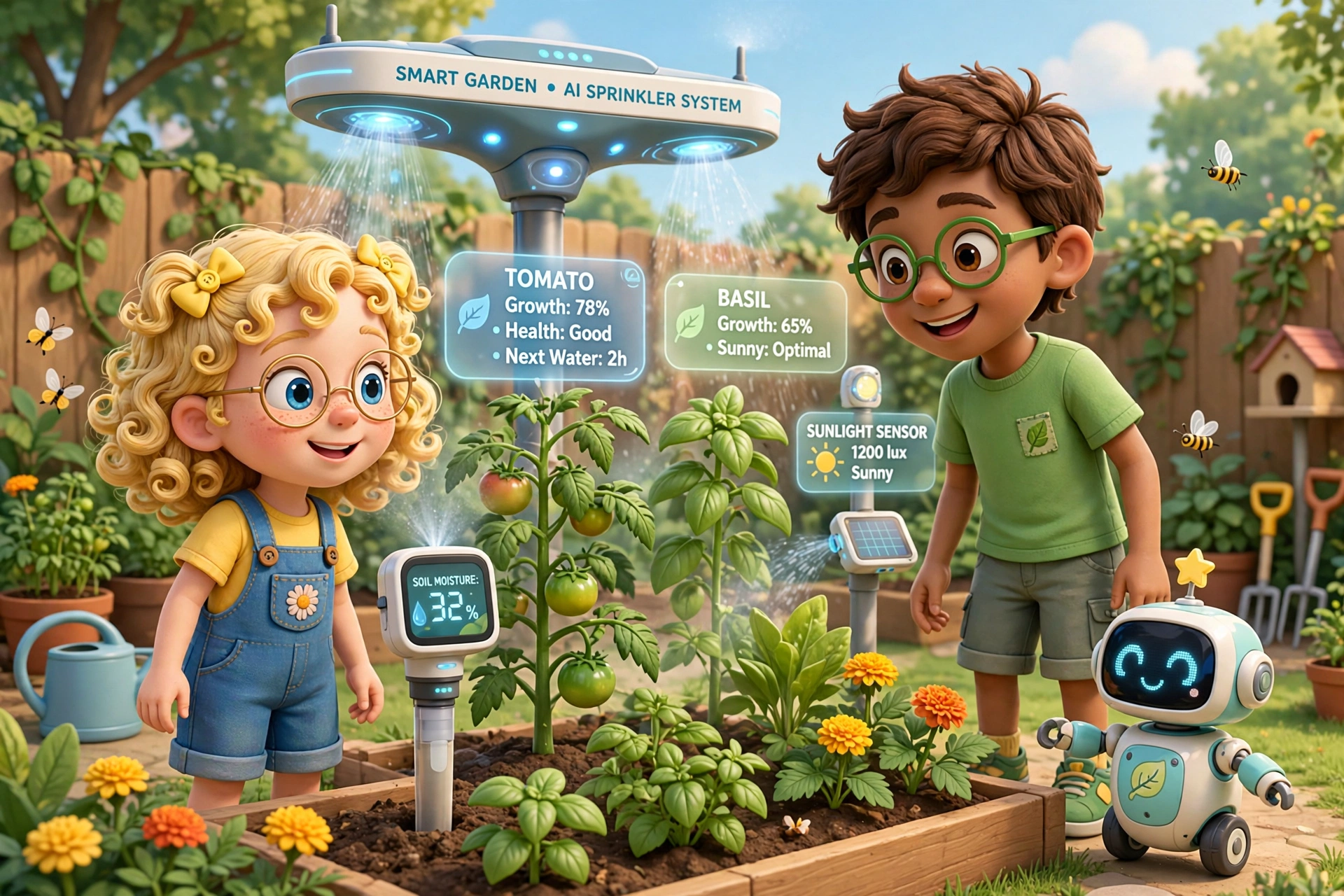
Direct resemblance to this AI Pre-Literacy story — Grandpa’s allotment at the moment the water system keeps watering only the near bed. The grey control box sits at the tap, screen glowing soft blue. The pipe runs down the near bed, where the tomatoes are plump and the lettuce is green. The probe sits in that bed — a small silver stick. At the far corner, past the courgettes, Grandpa’s bean leaves curl at the edges. That is the Blind Spot. Lina — age seven, blue overalls, yellow shirt, round glasses — stands by the grey box with one hand on the lid. Omar — age eight, green shirt, green glasses — stands by the beans with his arms folded. Pip stands between them. Grandpa kneels at the far corner with his hand in the soil. On the wooden bench: the open notebook and a second unopened probe.
Use Day 3-4: Point and name together — Where is the grey control box? Where does the pipe run? Where is the probe, and which bed is it in? Which bed is plump and green? Which bed is dry and curling? Where is Lina standing, and what is she touching? Where is Omar standing, and what are his arms doing? Where is Grandpa kneeling, and what is in his hand? Now look at the bench. What is on it? That notebook is the Ground Truth. Where you put the one probe is Sensor Placement. The bed with no probe is the Blind Spot. And a model that only knows the near bed has thin Coverage.
4. Meet Your 10 Special Words
AI Pre-Literacy · Story 6 · Tap a card to hear the word
5. Quiz — Did You Catch It?
Story 6 Quiz — tap the answer
1. Which word means: “The human record the model learns from — Grandpa’s notebook, morning by morning”?
2. Which word means: “What the probe measures — how much water is in the soil”?
3. Which word means: “A plan for when to water, and how much — for every bed”?
4. Which word means: “Where you put the probe decides what the model can see”?
5. Which word means: “The AI looking at a leaf and saying what it is”?
6. Which word means: “Measuring, day by day, how much taller, how much greener”?
7. Which word means: “Finding a bug on a leaf before a person does”?
8. Which word means: “A place the model cannot see — because it has never had a reading from there”?
9. Which word means: “When the world changes, and the model does not”?
10. Which word means: “How wide the model has seen — a model is only as wide as the places it has watched”?
6. Image 2 — Creator Prompt (Day 5: Imagination Studio)
This image is NOT in this AI Pre-Literacy story — this one is YOURS.
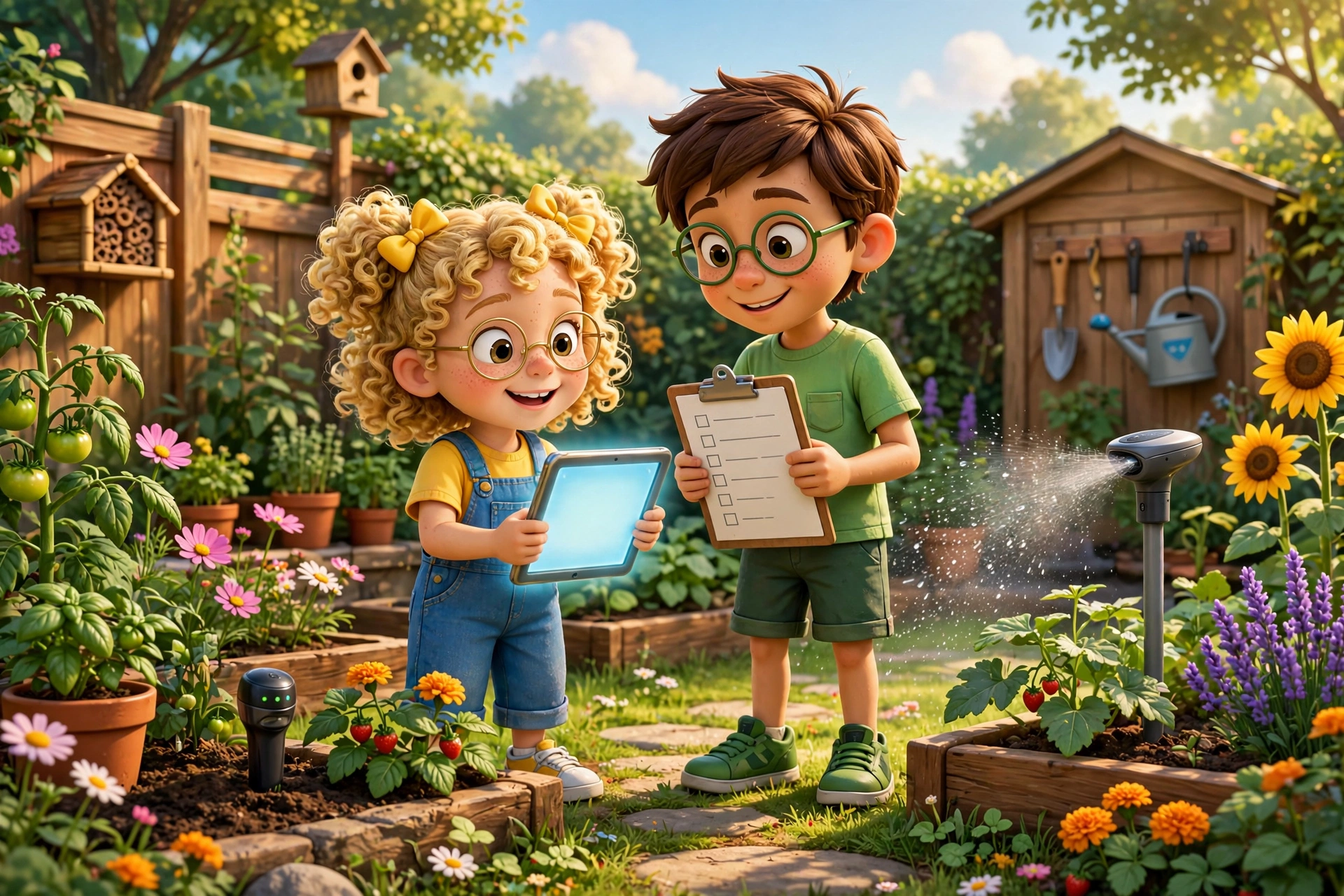
Look at this picture together. You already know Lina and Omar and Pip. You know what happened in Grandpa’s garden. Now this picture shows you something new — something that did not happen in the story.
Ask your child: Who is in this picture? Where are they? There is a third bed at the bottom of the page with no probe and no pipe — what would you plant there? Where would you put the probe, and why? What would go in Grandpa’s notebook that the probe cannot see — the shade, the slope, the wind? If the model waters one bed and forgets another, what should it do? Who should it ask? Draw the third bed. Draw the probe. Write one line in the notebook.
Let your child tell you the story out loud. Do not correct it. There is no wrong answer.
Then, if they want to, they can draw it.
For Parents & Teachers
Loading…