
AI Pre-Literacy Story 1: The Workshop Where Pip Learns to Listen
Grandpa’s workshop — birdhouse day · 8 words one per day · AI Pre-Literacy story
1. Story — Text-Based (Day 1-2: Imagination Studio)
Read this AI Pre-Literacy story with NO pictures first. Child becomes illustrator.
Lina and Omar are in Grandpa’s workshop behind the house. Lina is six and Omar is seven. The workshop smells of cut wood and warm dust.
Grandpa is making a birdhouse for the garden. He has cut all the pieces and set them in a row on the long wooden bench. Six short pieces. Two long ones. A roof shaped like a triangle.
At the end of the row is one last piece of pale wood — soft and light-coloured — cut from an old tree that fell in the garden last winter. There is no more.
Pip sits on the bench beside the pieces. Pip is the workshop’s listening bot — a small round helper with one camera eye and two soft ears.
Inside Pip’s ears are tiny Sensors. A Sensor is a part that feels something — light, or heat, or sound. Pip’s Sensors feel sound.
“Pip hears Voice Input now,” says Grandpa. Voice Input is the sound of a person’s voice, given to a machine to understand.
“Hey Pip,” says Lina. Her voice is clear and close. Pip’s screen lights up.
“Hey Pip” is the Wake Word,” says Grandpa. A Wake Word tells the machine it is time to listen.
Omar stands at the far side of the bench. “Pip, hand me the short piece,” he says.
The saw is running. The blade whines. Sawdust drifts through the light.
Pip’s screen shows a word. Not “short.” Transcription is what the machine hears, written down. Pip has written the wrong word.
Pip picks up the long piece. Omar is not expecting it. He swings his hammer. The long piece splits straight down the middle.
The last piece of pale wood is broken. There is no more. The birdhouse cannot be finished today.
“Pip heard me wrong,” says Omar. He is quiet. “I said short.”
“You spoke from the other side of the bench,” says Lina. “I spoke right next to Pip. That is why Pip heard me.”
“So it is my fault,” says Omar.
“It is the saw,” says Lina. “It never stopped.”
“Then the saw broke the birdhouse,” says Omar.
“No,” says Lina. “We did. We told Pip to listen in a loud room.”
They stand on either side of the bench. Neither one moves.
Grandpa puts down his plane. He looks at the split piece. Then at Pip’s screen. He does not fix anything. “What did Pip hear?” he asks.
They look at the screen together. The word is there. Tall. Not short.
“Tall and short are close sounds,” says Lina. “The saw filled in the middle.”
“Pip could not tell the saw from the voice,” says Omar. “Both came through the ears at once.”
Grandpa nods slowly. “So Pip needs Denoise,” he says. Denoise is what a machine does to take the noise out and keep only the voice.
“And Pip needs to know which sounds are words,” says Lina.
“That is Intent Detection,” says Grandpa. Intent Detection is a machine figuring out what a person really wants — not only the sounds, but the meaning under them.
“And Pip needs to know what we were doing before,” says Omar. “We were building a birdhouse. Short pieces. Small screws.”
“Then Pip must Check before it moves,” says Grandpa. “Check means going through it one more time. If Pip is not sure, Pip asks.”
“And Pip needs tuning,” says Lina. “Its ears are set too soft, or too loud.”
“That is Calibration,” says Grandpa. Calibration is turning the dials so a machine reads true.
They spend the afternoon tuning Pip. Grandpa turns one dial. Lina speaks close. Omar speaks far. They test with the saw running.
The new rule is simple: if Pip is not sure, Pip asks.
They test again. “Pip, hand me the short piece,” says Omar, from far away, with the saw running.
Pip’s screen pauses. Then it shows: “Did you say short?” Omar says yes. Pip hands him the short piece.
The birdhouse is finished by supper. Lina holds the wall. Omar sets the roof. Pip listens — through the saw, through the dust, through the warm noise of the workshop. Three hands, one birdhouse, and a small round bot who learned to ask before it moved.
2. Image 1 — Association Anchor (Day 3-4)
Top of Image 1 — This is what you just read, now you can see it.
3. What is the purpose of this Image 1?
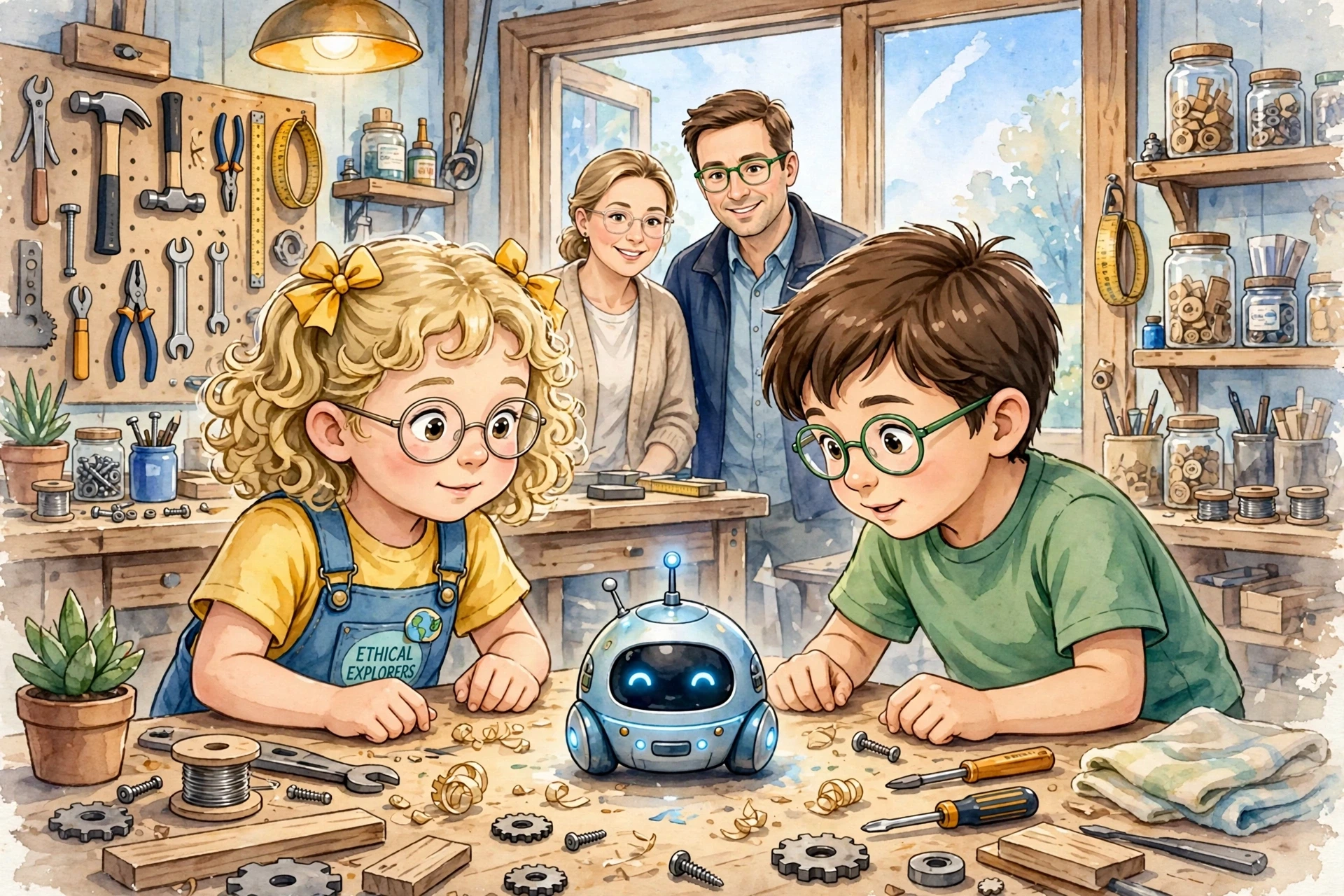
Direct resemblance to this AI Pre-Literacy story — Grandpa’s workshop behind the house. The long wooden bench with the row of cut pieces: six short, two long, one triangular roof. At the end of the row, the last pale piece of wood. Pip sits on the bench — small and round, one camera eye, two soft ears, screen glowing with the mis-transcribed word. The saw on its stand in the background, sawdust drifting in the light. Lina stands close to Pip’s left ear. Omar stands at the far end of the bench. Grandpa’s plane is set down beside the split piece of wood.
Use Day 3-4: Point and name together — Where is Pip’s camera eye? Where are the soft ears? Where is the screen, and what word is on it? Where is the row of cut pieces — how many are there? Where is the last pale piece of wood? Where is the saw, and is it running? Where is Lina standing? Where is Omar standing — how far from Pip? Where is Grandpa, and what has he put down? Now look at the split piece of wood. What happened there? That is the cost of one wrong word.
4. Meet Your 8 Special Words — One Per Day
AI Pre-Literacy · Story 1 · Tap a card to hear the word
5. Quiz — Did You Catch It?
Story 1 Quiz — tap the answer
1. Which word means: “The sound of a person’s voice, given to a machine to understand”?
2. Which word means: “The phrase that tells a machine it is time to listen”?
3. Which word means: “Taking the noise out and keeping only the voice”?
4. Which word means: “What the machine hears, written down”?
5. Which word means: “Figuring out what a person really wants — not just the sounds”?
6. Which word means: “Turning the dials so a machine reads true”?
7. Which word means: “A part that feels something — light, or heat, or sound”?
8. Which word means: “Going through it one more time before you move”?
6. Image 2 — Creator Prompt (Day 5: Imagination Studio)
This image is NOT in this AI Pre-Literacy story — this one is YOURS.
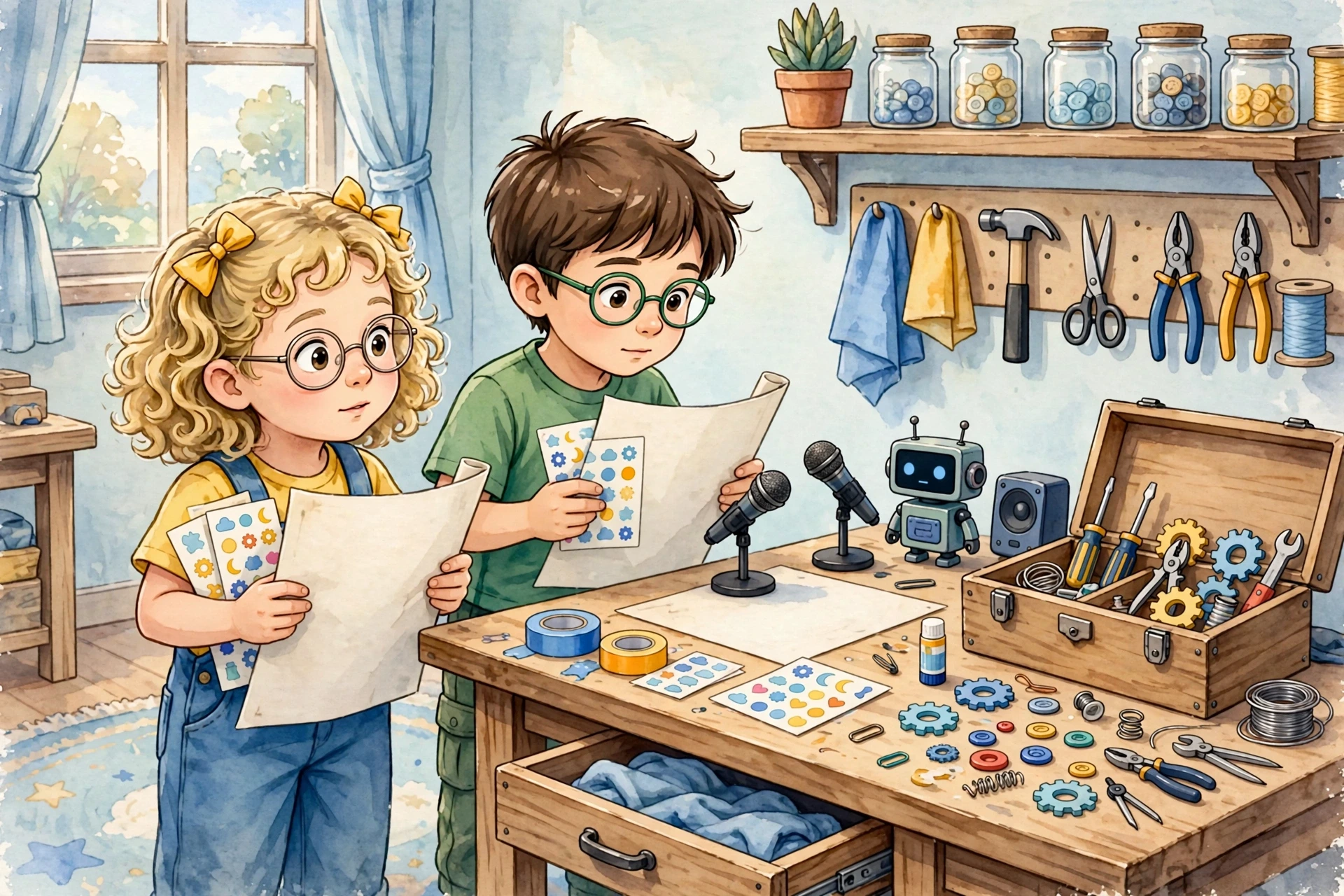
Look at this picture together. You already know Lina and Omar and Pip. You know what happened in Grandpa’s workshop. Now this picture shows you something new — something that did not happen in the story.
Ask your child: Who is in this picture? Where are they? What are they building, or fixing, or designing? Is Pip here too? What is Pip listening for? What would YOU tell a machine to do? What should it do if it is not sure?
Let your child tell you the story out loud. Do not correct it. There is no wrong answer.
Then, if they want to, they can draw it.
For Parents & Teachers
Loading…