
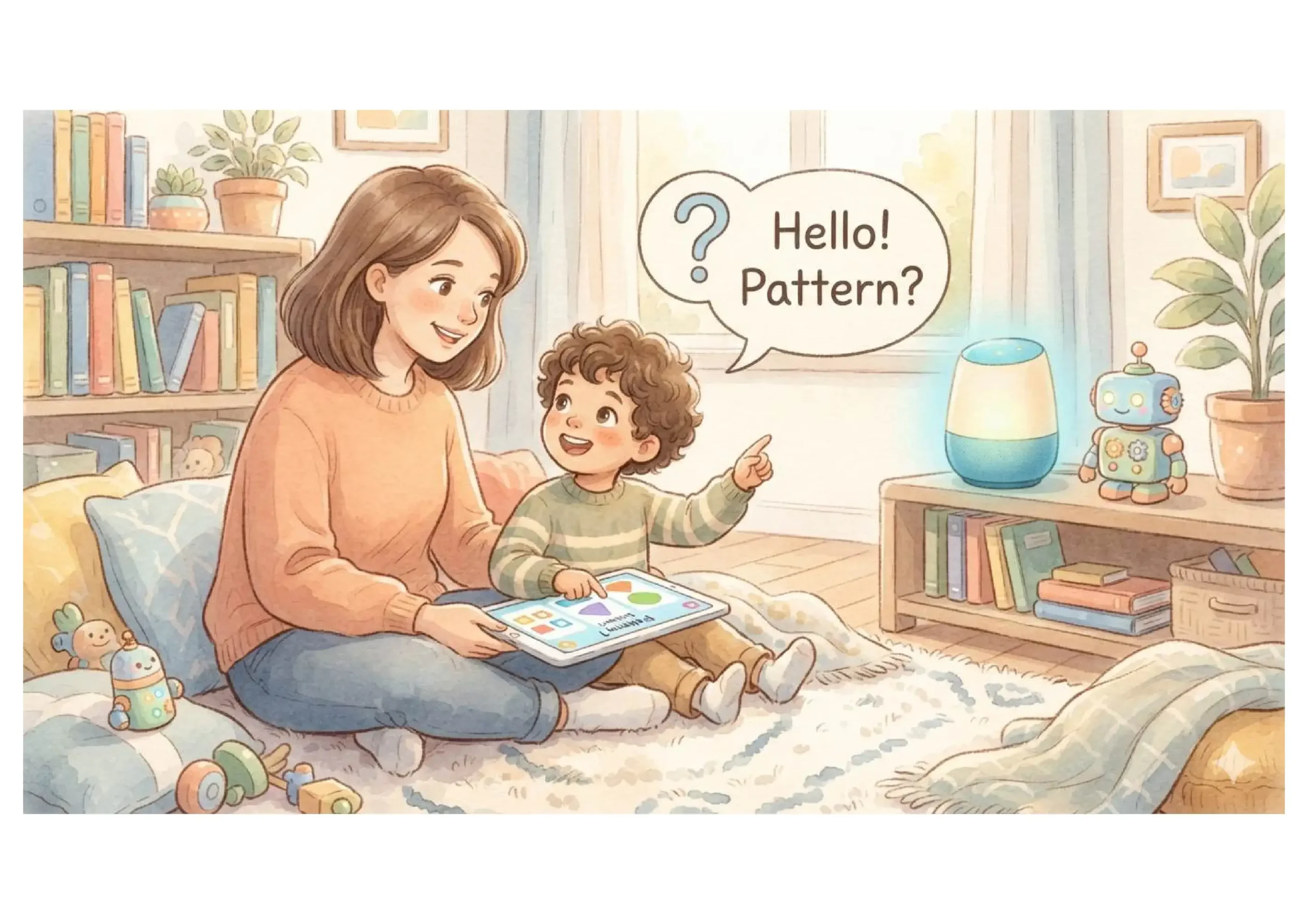
“Mom, how does Alexa know the answer?”
“Dad, why does the tablet always know what I want to watch next?”
“Where does the voice come from?”
If your child has ever asked a question like this, they are already showing you something important: they are ready to learn about AI.
Many parents wonder when the “right time” is to start talking about artificial intelligence with their young children. The answer is simpler than you might think. Children do not need to wait until they are old enough to understand complex programming concepts. They are already interacting with AI every day — through voice assistants, recommendation algorithms, smart toys, and conversational agents.
The question is not whether your child is ready. The question is whether you are noticing the signs.
This post explores five clear signs that your child is ready to begin their AI pre‑literacy journey — and what you can do to support them.
The Problem
Many parents feel uncertain about when to introduce AI concepts to their children. Some worry that AI is too complex for young minds. Others fear that talking about technology too early might replace the simple joys of childhood.
These concerns are understandable. But they are also misplaced.
Children are forming ideas about AI whether we talk to them about it or not. A 2025 study exploring young children’s understanding of AI found that children develop conceptualizations of AI grounded in their personal experiences—they understand AI as a supportive tool and show a high level of engagement with the ethics of AI, particularly about AI applications with which they are familiar. In other words, children are already thinking about AI. They are just doing it without guidance.
Without guidance, these natural curiosities can become misconceptions. Children may believe that the voice in the smart speaker is a person, that the tablet’s recommendations are magic, or that AI is always right. They may trust what AI tells them without question. They may share personal information without understanding the consequences.
Research published in 2026 found that young children aged 4–5 can develop foundational AI literacy that integrates technical comprehension, communicative adaptation, and relational ethics. The same study found that children “demonstrated an emerging understanding of AI mechanisms, recognizing technical limitations while perceiving robots as emotionally relatable entities.” They also “employed strategic behaviors, such as modifying speech and regulating turn‑taking, to overcome technical challenges” and “exhibited ethical responsibility as active agents, valuing information accuracy and practicing relational ethics of care.”
The evidence is clear: young children are capable of learning about AI. They are ready far earlier than most parents realize. And the signs are already there—if you know what to look for.
The Solution / Argument
The solution is not to wait for a “right age” or a formal curriculum. The solution is to recognize the signs of readiness and respond to them with simple, age‑appropriate conversations and activities.
AI pre‑literacy is not about turning your child into a programmer. It is about building awareness, safe habits, critical thinking, and a healthy relationship with intelligent technologies. It starts not with coding, but with vocabulary. Not with screens alone, but with conversations.
Children as young as 4‑7 are in what neuroscientists call the “golden window” for developing pattern recognition and classification abilities—fundamental skills of algorithmic thinking and machine learning. A 2024 study published in the Korean Journal of Child Studies found that young children “can develop foundational AI literacy that integrates technical comprehension, communicative adaptation, and relational ethics.”
The world’s leading international organizations agree that early AI literacy matters. The OECD, in its AI Literacy Framework, defines AI literacy as “a set of knowledge, skills, and attitudes” that “equips learners to understand how AI systems work, critically evaluate their outputs, and use them ethically and creatively.” UNESCO, through its AI Competency Framework for Students, outlines competencies across four dimensions, including AI techniques and applications, AI ethics, and AI system design. UNICEF, through its Guidance on AI and Children, emphasizes the importance of preparing and skilling children for present and future developments in AI.
These frameworks are not just for older students. They begin with foundational awareness—and foundational awareness begins in early childhood.
The question is not whether your child is ready. The question is whether you are ready to notice the signs.
Evidence / Examples
Here are five signs that your child is ready to learn about AI—backed by research and expert guidance.
Sign 1: They Ask “How” and “Why” Questions About Technology
“Where does the voice come from?”
“How does the tablet know what I like?”
“Why does the robot do that?”
When children ask questions about how things work, they are demonstrating natural curiosity and cognitive readiness. They are not just using technology — they are wondering about it. This is the foundation of critical thinking.
Research has shown that young children develop conceptualizations of AI grounded in their personal experiences. They are already forming ideas about what AI is and what it can do. When they start asking questions, they are inviting you into their thinking process.
What you can do: When your child asks a question about technology, answer it simply and honestly. Use friendly words like smart helper, voice command, and algorithm. You do not need to be a computer scientist — you just need to be curious alongside them.
Sign 2: They Notice When Technology “Gets It Wrong”
“Alexa didn’t understand me.”
“The tablet showed me something I don’t like.”
“The robot went the wrong way.”
Children who notice when technology makes mistakes are demonstrating critical awareness. They are not passively accepting whatever the device tells them—they are evaluating it.
A 2025 study found that children exhibit a high level of engagement with the ethics of AI, showing a keen interest in the socio‑cultural implications of AI applications. Even young children are capable of recognizing when something is “off” and questioning why it happened.
What you can do: When technology makes a mistake, use it as a teaching moment. Say: “The smart helper didn’t understand because it’s following instructions—sometimes it gets confused. That’s okay. We can try again.” This normalizes errors and builds resilience.
Sign 3: They Engage in Pretend Play with Technology
“I’m the robot—give me a command!”
“Let’s pretend this toy is a smart helper.”
“I’m telling the computer what to do.”
Pretend play is how young children make sense of the world. When they role‑play with technology, they are building mental models of how things work.
A 2026 study exploring young children’s understanding of AI through play‑based interactions found that children “employed strategic behaviors, such as modifying speech and regulating turn‑taking, to overcome technical challenges”. They were not just playing — they were learning to adapt their communication to work with technology.
What you can do: Join the play. Ask: “What happens if I give the robot a different command?” or “How does the smart helper know what to do?” These questions build vocabulary and understanding through play.
Sign 4: They Can Distinguish Between Real and Pretend
“The voice is not a real person.”
“It’s just a computer.”
“That’s not real — it’s pretend.”
Children who understand that technology is not a person are demonstrating cognitive differentiation—a key developmental milestone. They are beginning to recognize that AI systems are tools, not living beings.
The SIACC framework—Safety, Identity, Attitude, Cognition, and Capability—developed for early childhood AI literacy, includes Identity as a core dimension. This dimension helps children distinguish AI from people, question AI content, and maintain their agency.
What you can do: Affirm their understanding. Say: “That’s right—it’s a smart helper. It follows instructions that people gave it. It doesn’t think as we do.”
Sign 5: They Show Interest in Patterns and Sequences
“First this, then that.”
“These go together.”
“I see a pattern!”
Pattern recognition is a foundational skill for algorithmic thinking and machine learning. When children notice patterns, they are building the cognitive architecture that will later support understanding of how AI systems work.
Neuroscience studies show that the age range of 4–7 years old is the “golden window” for developing pattern recognition and classification abilities. In its 2024 report, UNESCO ranked “algorithmic ability” alongside reading, writing, and arithmetic, considering it the third most important skill of the 21st century.
What you can do: Play sorting and pattern games. Ask: “What comes next?” or “How do these go together?” Explain that AI does something similar—it looks at patterns in data to make predictions.
Summary of Signs
| Sign | What It Looks Like | What You Can Do |
| 1. Asks “how” and “why” | “How does Alexa know the answer?” | Answer simply; use friendly AI vocabulary |
| 2. Notices tech mistakes | “The tablet showed me something wrong.” | Normalize errors—”Sometimes it gets confused” |
| 3. Pretend play with tech | “I’m the robot—give me a command!” | Join the play; ask questions |
| 4. Distinguishes real from pretend | “The voice is not a real person.” | Affirm their understanding |
| 5. Shows interest in patterns | “These go together!” | Play sorting and pattern games |
Practical Takeaways
Here is what parents can do to support their child’s AI readiness:
- Notice the signs. Your child is already showing you they are ready. Pay attention to their questions, their play, and their curiosity.
- Start with vocabulary. Words like smart helper, voice command, sensor, algorithm, and cloud give children the language to understand what they are interacting with.
- Make it a shared experience. The World Health Organization and the American Academy of Pediatrics both recommend that screen time for young children be shared with a trusted adult. Use that time as an opportunity for conversation, not just consumption.
- Normalize mistakes. When technology gets it wrong, say: “That’s okay—sometimes smart helpers get confused. Let’s try again.” This builds resilience and critical thinking.
- Read stories together. Our Tech Tales series introduces AI vocabulary through gentle, engaging stories about Leo and Pip the Smart Helper. Each story is free, ad‑free, and designed to be enjoyed with a grown‑up nearby.
- Follow their curiosity. If your child is fascinated by a particular technology, explore it together. You do not need to be an expert—you just need to be curious.
- Remember the goal. AI pre‑literacy is not about turning your child into a programmer. It is about helping them grow up comfortable, confident, and critical about the technologies that will shape their world.
A Positive Conclusion
Your child is ready to learn about AI. They have been showing you the signs all along — in their questions, their play, and their wonder.
You do not need to be a computer scientist. You do not need a formal curriculum. You just need to notice the signs and respond with curiosity, conversation, and care.
UNESCO reminds us that the goal is to prepare young people to be “responsible users and co‑creators of AI”. The OECD reminds us that AI literacy is essential for future generations. UNICEF reminds us that AI should work in the best interests of children everywhere.
These are not distant ideals. They begin with a single question, a single conversation, a single moment of wonder.
Your child is ready. And so are you.
What About You?
Have you noticed any of these signs in your child? What questions have they asked about the technology they use — and how did you respond? Share your experience in the comments — we would love to hear how families are noticing and nurturing AI readiness.
About the Authors
Dr. Shaheen Pasha PhD in Special Education, University of Southampton, UK. Author of Educational Psychology and Exceptional Children; former Professor and Chairperson at the University of Education, Lahore; has advised national education bodies
Dr. M. Anwar-ur-Rehman Pasha PhD in Computer Science (Artificial Intelligence), University of Southampton, UK. Author of multiple academic books; former Professor, Rector, and Dean; has helped shape computing and AI education in Pakistan
Two educators with a combined 70 years of experience in education, research, and curriculum design
References
Bae, J. H., & Lee, B. (2026). Emerging Understanding of AI Literacy and Ethics in Young Children: A Qualitative Exploration. Korean Journal of Child Studies, 47(1), 139‑157.
Luo, W., et al. (2026). Are Chinese Preschoolers Ready for the AI Era? Evidence from a Large‑Scale National Study in China. Early Education and Development.
OECD. (2025). Empowering Learners for the Age of AI: An AI Literacy Framework for Primary and Secondary Education.
UNESCO. (2024). AI Competency Framework for Students.
UNICEF. (2025). Guidance on AI and Children (Version 3.0).
Vinschool. (2025). Vinschool Introduces AI into Kindergarten. Vietnam.vn.