
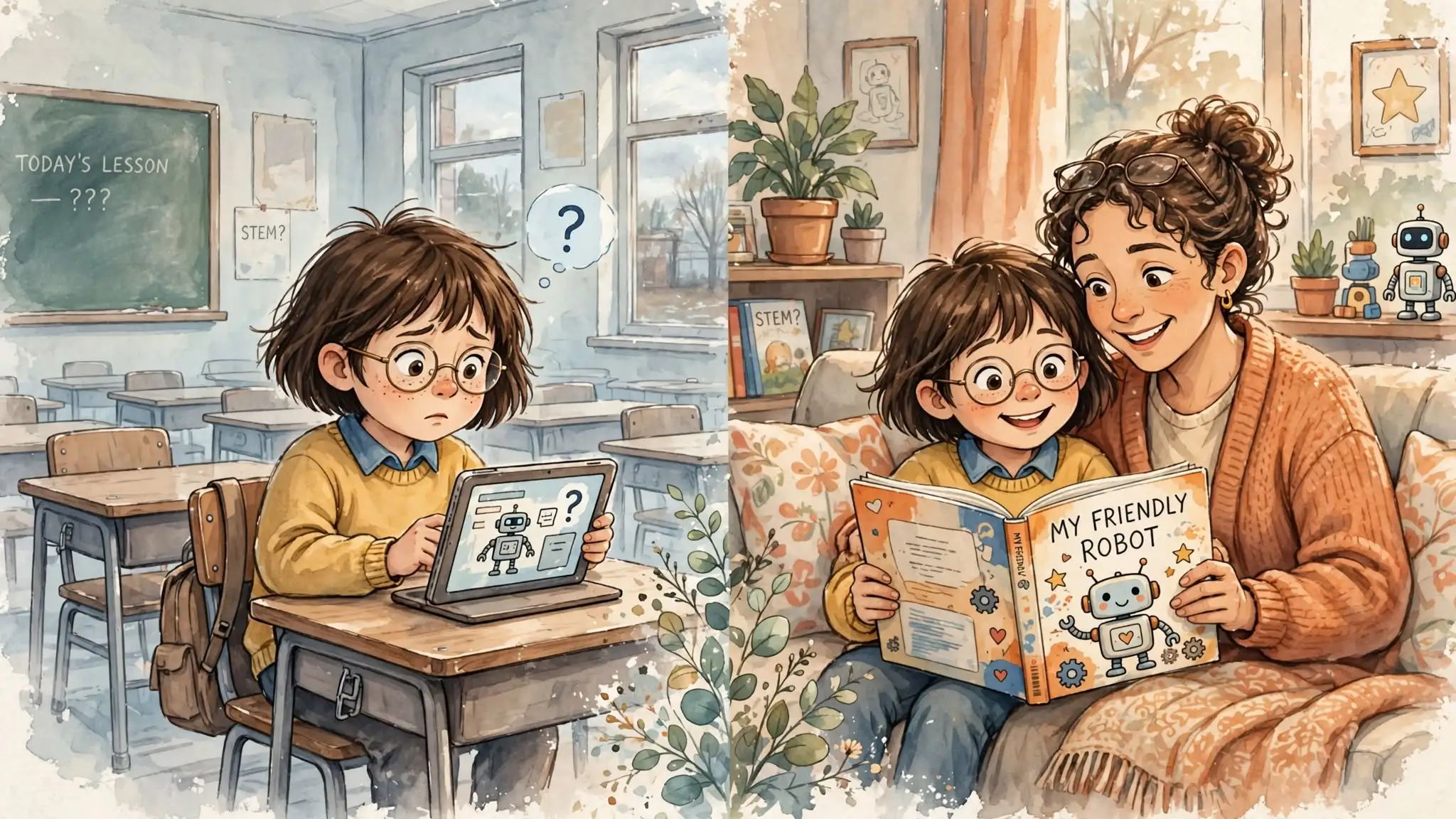
Imagine your child’s school report card. It lists reading, writing, mathematics, science, and social studies. Perhaps it even includes computer skills or coding.
Now imagine a new line: Artificial Intelligence Literacy.
For most parents, that line does not exist. For most schools, it is not even on the horizon.
Yet your child is already using AI every day. They ask voice assistants questions. They watch shows recommended by algorithms. They play games with adaptive opponents. They interact with intelligent technologies that their teachers — and even their school curricula — do not yet know how to explain.
The AI curriculum is hidden. Not because schools do not want to teach it. But because they are not yet ready.
This post explores what schools are not teaching about AI, why that matters, and what parents can do to fill the gap.
The Problem
Children are adopting AI technologies faster than schools can keep up. In fact, UNICEF has observed that children are adopting AI more than three times faster than adults. Yet most education systems are not preparing them to engage deeply with AI or to understand how to use it safely.
The numbers paint a stark picture. A 2025 report by the Milken Institute found that 60 percent of U.S. schools or districts have no guidance for generative AI usage. More than half of schools are operating without any framework for helping students understand the technology they use daily.
The problem is not limited to the United States. In South Korea, researchers have identified a growing “AI literacy gap” as children embrace AI tools while education on their implications remains noticeably absent. One Korean parent expressed a concern shared by many: “These days, children turn to AI first when they have questions, and I worry they might lose their ability to think and express themselves”.
Why are schools so unprepared? Several factors are at play:
1. Teachers lack training and confidence. A 2025 study found that 57.7% of pre-service preschool and primary school teachers feel insufficiently prepared to use AI, mainly due to lack of knowledge, practical skills, and technological mistrust. Many teachers have never been introduced to the concept of AI literacy themselves. According to the Milken report, only 17 percent of current computer science teachers have computer science degrees. “If you’ve been a teacher for 20 years, suddenly, you may not be an expert,” one analyst noted.
2. There are no clear standards. A 2025 study found that “AI in education remains a nascent field, with no clear guidelines on what to teach or how to pedagogically leverage AI”. The Royal Society warns that without a shared baseline, “AI literacy risks becoming dependent on local initiatives or individual teacher expertise, widening educational inequalities”.
3. Curricula are not designed for young children. Many AI-driven curricula focus on older age groups or advanced technical skills. As one researcher put it: “We don’t yet have an age-appropriate learning progression for AI concepts”.
4. Early childhood educators are being left out. As one education leader observed, “early childhood educators are being left out of the conversation entirely”. Policymakers and technologists rushing to prepare K‑12 schools for an AI‑powered future “risk overlooking a critical window: the early years, when children’s brains are developing faster than at any other point in life”.
The result is a generation of children using AI without understanding it — and a school system that does not yet know how to help.
The Solution / Argument
The solution is not to wait for schools to catch up. That could take years — or even decades. The solution is to recognise that AI literacy must begin at home, in the early years, before formal schooling even starts.
The world’s leading international organisations have made it clear that AI literacy is essential — and that it must begin early.
UNESCO, in its AI Competency Framework for Students launched during Digital Learning Week 2024, outlines 12 competencies across four dimensions: a human‑centred mindset, ethics of AI, AI techniques and applications, and AI system design. The framework aims to guide policymakers, educators, and curriculum developers in providing students with the knowledge, skills, and values needed to use AI effectively.
The OECD and the European Commission, in May 2025, jointly launched a draft AI Literacy Framework for primary and secondary education. The framework outlines 22 competences across four domains: engage with AI, create with AI, manage AI, and design AI. It defines AI literacy as “the technical knowledge, durable skills, and future‑ready attitudes required to thrive in a world influenced by AI”. The framework will provide the foundation for the first assessment of AI Literacy in the OECD’s Programme for International Student Assessment (PISA) in 2029.
UNICEF, through its Guidance on AI and Children, emphasises that AI systems should work in the best interests of children everywhere, and that preparing and skilling children for present and future developments in AI is essential.
These frameworks are significant. They represent a global consensus that AI literacy is no longer optional. But they also reveal a gap: they focus primarily on primary and secondary education, with less attention to the early years when foundational skills begin to develop.
This is where AI pre‑literacy comes in. It is the developmental stage — typically between the ages of 2 and 7 — where the goal is not to teach coding or technical concepts, but to build awareness, safe habits, critical thinking, and a healthy relationship with intelligent technologies.
As one education leader put it: “Waiting until kindergarten to start teaching AI literacy misses a key window of opportunity”. The foundational skills that matter most — creativity, critical thinking, empathy, resilience — “start to take root long before formal schooling begins”.
Evidence / Examples
Evidence is mounting that schools are not keeping pace with the AI revolution — and the consequences are already visible.
Children are forming misconceptions without guidance. A 2025 study found that younger students typically exhibit minimal or anthropomorphic views of AI, reflecting limited exposure to basic AI principles. Older students show somewhat more advanced, yet still partial, understandings, with misconceptions persisting across all groups. The study underscored “the importance of integrating AI literacy into school curricula and aligning instruction with students’ developmental stages”.
Teachers are “flying blind.” A 2025 report by the Royal Society found that over half of UK teachers already use AI for planning and marking, yet most lack training or confidence to teach about AI itself. Teachers are using AI tools without understanding how to explain them to students — a gap that could have serious implications for children’s learning.
Gender gaps are emerging early. A 2025 study found that “gender disparities in AI literacy emerge at the foundational level”. Without early, inclusive education, “students — especially girls facing STEM‑related barriers — may lack the skills and confidence to engage with AI”. The study also found that these disparities can be reduced through targeted AI literacy instruction.
The AI divide is growing. Children in well‑resourced schools may receive cutting‑edge AI education, while those in under‑resourced schools struggle with basic technology access. Without a shared baseline, AI literacy risks becoming yet another dimension of educational inequality.
AI corporations are changing policies faster than schools. Companies like Google, Anthropic, and xAI are relaxing age restrictions to allow children under 13 to use generative AI. In May 2025, Google changed its policy to allow children using accounts with Family Link to access Gemini. Elon Musk’s xAI announced plans to create an AI chatbot specifically for children called “Baby Grok”. Children are being given access to powerful AI tools — without any guarantee that they understand what they are using or how to use it safely.
The PISA 2029 assessment will measure AI literacy. This is both a sign of progress and an indictment of the current system. If AI literacy is important enough to be assessed in PISA 2029, why are schools not teaching it today?
Practical Takeaways
Here is what parents can do today to fill the hidden AI curriculum gap:
- Do not wait for schools. AI literacy is too important to leave to an education system that is not yet ready. Start the conversation at home — today.
- Build vocabulary early. Words like smart helper, voice command, sensor, algorithm, and cloud give children the language to understand what they are interacting with.
- Make it a shared experience. The World Health Organization and the American Academy of Pediatrics both recommend that screen time for young children be shared with a trusted adult. Use that time as an opportunity for conversation, not just consumption.
- Ask questions. When your child uses a voice assistant or watches a recommended show, ask: “Why do you think it suggested that?” “How do you think it knows what you like?” “Do you think that’s always right?”
- Read stories together. Our Tech Tales series introduces AI vocabulary through gentle, engaging stories about Leo and Pip the Smart Helper. Each story is free, ad‑free, and designed to be enjoyed with a grown‑up nearby.
- Advocate for AI literacy in your child’s school. Ask teachers and school leaders what they are doing to prepare children for an AI‑driven world. Share resources like the UNESCO and OECD frameworks with them.
- Remember the goal. AI pre‑literacy is not about turning your child into a programmer. It is about helping them grow up comfortable, confident, and critical about the technologies that will shape their world.
A Positive Conclusion
The hidden AI curriculum is a problem — but it is also an opportunity. It is an opportunity for parents to take the lead. It is an opportunity to start the conversation early, before schools catch up. It is an opportunity to give children the vocabulary, the curiosity, and the critical thinking skills they need to navigate an AI‑driven world with confidence.
UNESCO reminds us that the goal is to prepare young people to be “responsible users and co‑creators of AI”. The OECD reminds us that AI literacy represents “the technical knowledge, durable skills, and future‑ready attitudes required to thrive in a world influenced by AI”. UNICEF reminds us that AI should work in the best interests of children everywhere.
These are not distant ideals. They are achievable goals. And they begin not with a keyboard, but with a question. Not with code, but with a story. Not with a screen alone, but with a grown‑up nearby.
The hidden AI curriculum does not have to stay hidden. We can bring it into the light — starting today.
What About You?
Have you noticed the AI curriculum gap in your child’s school? What questions have your children asked about the technology they use — and how have you responded? Share your experience in the comments — we would love to hear how families are navigating this gap.
About the Authors
Dr. Shaheen Pasha—Retired Professor of Special Education. Ph.D., University of Southampton, UK. Former Chairperson, Department of Special Education, University of Education, Lahore. 35+ research papers, 2 books.
Dr. M. A. Pasha—Retired Professor of Computer Science. Ph.D. in Artificial Intelligence, University of Southampton, UK (1996). Research: AI, Human-Computer Interaction, Computational Thinking. 30+ research papers, 2 books.
Their mission: 70 years of combined academic wisdom, united to foster AI pre literacy in young children.
References
- UNESCO. (2024). AI Competency Framework for Students. UNESCO Digital Library.
- OECD & European Commission. (2025). Empowering Learners for the Age of AI: An AI Literacy Framework for Primary and Secondary Education (Draft).
- Milken Institute. (2025). The Computing Imperative: Building America’s Talent Engine in the Age of AI.
- Royal Society. (2025). Artificial Intelligence in Education.
- Korea faces AI literacy gap as child AI usage rises among students. (2025, July 22). Chosun Biz.
- Why AI Literacy Instruction Needs to Start Before Kindergarten. (2025, July 24). The 74 Million.
- Lack of Guidelines and Expertise Prove Challenging for AI Use in Schools. (2025, December 2). EdSurge.
- Pre‑Service Preschool and Primary School Teachers’ Attitudes on Artificial Intelligence. (2025).
- Exploring Challenges and Opportunities in AI Literacy. (2025). Proceedings of the 2025 8th International Conference on Big Data and Education.
- UNICEF. (2025). Guidance on AI and Children (Version 3.0). UNICEF Innocenti.