In our previous article, we argued that AI pre-literacy begins with the human child—not the technology.
The next question is practical:
What does a child aged 3–7 actually need before formal AI literacy becomes developmentally meaningful?
The answer is not a smaller version of an AI curriculum.
It is a stronger foundation for learning.
First, We Should Be Careful
Research shows that young children can learn basic AI concepts when activities are appropriately designed. A study of an eight-week AI-literacy programme involving children with an average age of four found that children could learn basic AI concepts and engage in AI-related creative activities (Su & Yang, 2023/2024).
This is important.
It means that the argument for AI pre-literacy is not that young children are incapable of learning about AI.
The question is what should be developed alongside or before formal AI concepts.
A 2023 scoping review also found that AI literacy in early childhood remains an emerging area, with research addressing curriculum design, tools, pedagogy, assessment, and learning outcomes (Su et al., 2023).
What Comes First?
1. Language to Make Meaning
Children need to be able to describe what they see, communicate what they think, and ask questions about what they experience.
Parents can encourage children to explain:
What happened? Why do you think it happened? What could happen next?
These simple conversations help children build the language through which later technological concepts can become meaningful.
2. Curiosity to Question
AI literacy ultimately requires critical questioning and judgement (Long & Magerko, 2020).
But critical questioning does not begin with AI.
It begins with the child’s natural “Why?”
Parents should therefore protect curiosity rather than rush to provide every answer.
A child who learns to question the world is developing a capacity that will later become important when questioning AI.
3. Imagination to Explore Possibilities
Young children learn through imagination, representation, experimentation, and play.
These experiences allow children to explore what might happen, not simply what already exists.
That matters in an AI-driven world where children will increasingly encounter systems that generate stories, images, voices, recommendations, and responses.
Before children need to understand how such systems work, they need opportunities to distinguish experience, imagination, representation, and reality.
4. Agency to Make Choices
AI systems increasingly recommend, generate, select, and respond.
Children therefore need opportunities to experience themselves as decision-makers.
Parents can provide simple choices, allow children to attempt solutions, and discuss the consequences of their decisions.
The purpose is not to teach children “AI agency.”
It is to strengthen human agency.
This is consistent with UNESCO’s AI Competency Framework, which places human-centred mindset, human agency, accountability, and AI ethics alongside AI-specific competencies.
5. Relationships to Develop Social Understanding
Children do not develop in isolation.
Through relationships with parents, siblings, teachers, and peers, they learn to cooperate, negotiate, listen, trust, care, and resolve disagreement.
These experiences provide foundations for later questions about AI:
Can I trust this? Is it fair? Who is responsible? Should a machine decide this?
AI pre-literacy therefore begins partly through human relationships, not through technological instruction.
6. Emerging Ethical Understanding
Children gradually encounter concepts such as fairness, kindness, responsibility, sharing, honesty, and respect.
Parents do not need to teach “AI ethics” to a four-year-old as a formal subject.
Instead, ordinary experiences can provide opportunities to discuss:
Was that fair? How did that make someone feel? Who should decide? What would be a responsible choice?
These are human foundations upon which later ethical reasoning about AI can develop.
What Parents Can Do
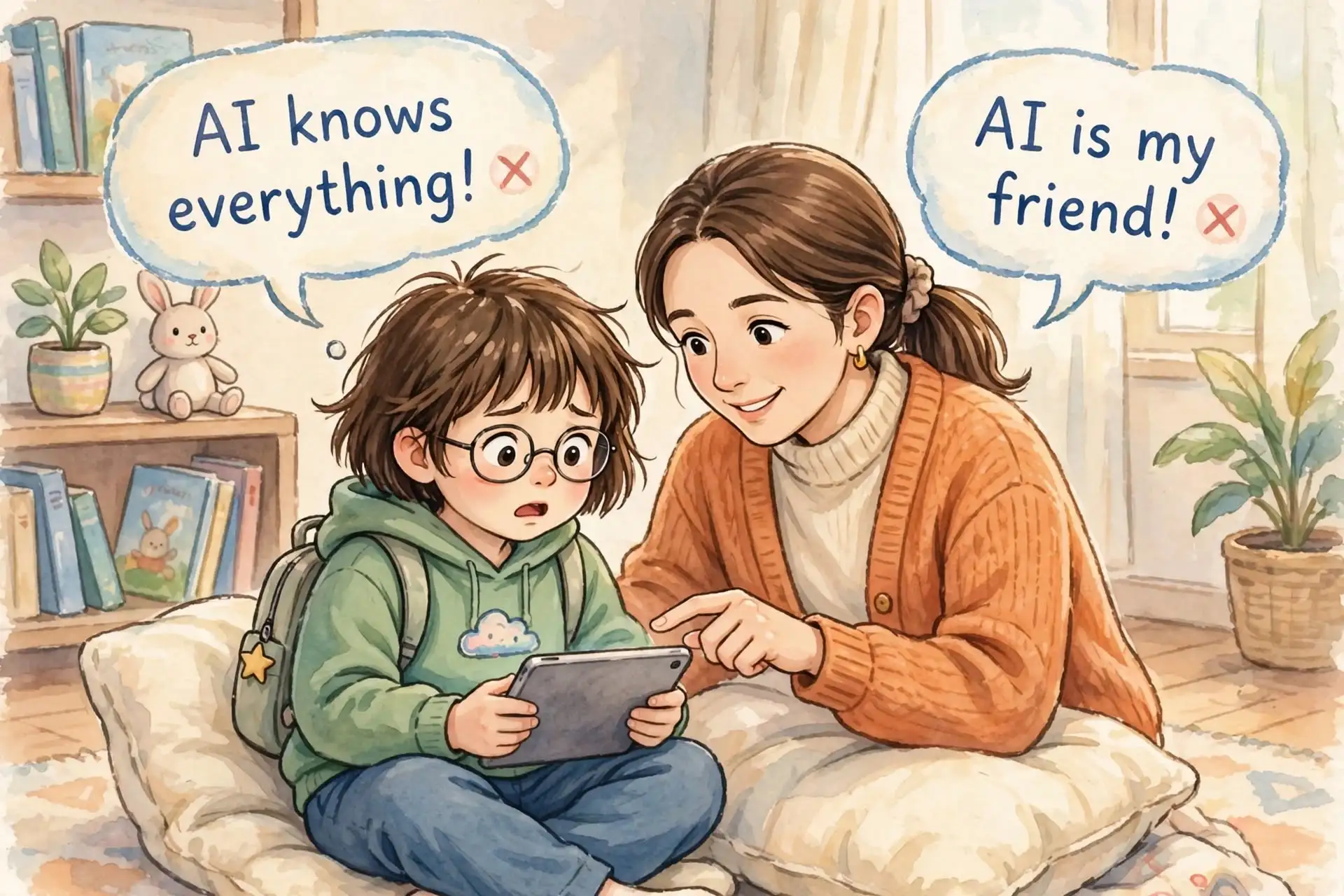
Parents do not need to purchase sophisticated AI toys or introduce technical AI lessons.
They can begin with ordinary childhood:
Talk. Read. Play. Ask. Listen. Let children wonder. Give them choices. Encourage imagination. Let them solve problems. Discuss fairness. Spend time with other people.
These activities may appear unrelated to AI.
They are not.
They help develop the human capacities through which children will eventually understand and evaluate AI.
UNICEF’s current guidance on AI and children similarly places children’s safety, privacy, fairness, transparency, accountability, and rights within the responsibility of the wider environment surrounding children—and provides specific guidance for parents.
The Principle
We therefore suggest a simple principle:
Before preparing children to understand artificial intelligence, we should prepare them to understand themselves, other people, and the world around them.
That is not a rejection of AI education.
It is a developmental foundation for it.
AI literacy may teach children about AI.
AI pre-literacy begins by strengthening the child who will encounter it.
Key Takeaway
For children aged 3–7, the most important preparation for an AI-driven world may begin with language, curiosity, imagination, agency, relationships, and emerging ethical understanding—not with coding or technical AI instruction.
What About You?
What do you think parents should protect most carefully as AI becomes increasingly present in children’s everyday lives?
We invite parents, teachers, educators, and researchers to share their perspectives.
References
Long, D., & Magerko, B. (2020). What is AI literacy? Competencies and design considerations. Proceedings of the 2020 CHI Conference on Human Factors in Computing Systems, 1–16. https://doi.org/10.1145/3313831.3376727
Su, J., Ng, D. T. K., & Chu, S. K. W. (2023). Artificial intelligence (AI) literacy in early childhood education: The challenges and opportunities. Computers and Education: Artificial Intelligence, 4, 100124. https://doi.org/10.1016/j.caeai.2023.100124
Su, J., & Yang, W. (2024). Artificial intelligence (AI) literacy in early childhood education: An intervention study in Hong Kong. Interactive Learning Environments, 32(9), 5494–5508. https://doi.org/10.1080/10494820.2023.2217864
UNESCO. (2024). AI competency framework for students. UNESCO.
UNICEF. (2025). Guidance on AI and children: Version 3.0—Recommendations for AI policies and systems that uphold child rights. UNICEF Office of Strategy and Evidence Innocenti.
About the Authors
Prof. Dr. Shaheen Pasha & Prof. Dr. Muhammad Anwar-ur-Rehman Pasha
Authors and education researchers working on children’s development, education, and the implications of artificial intelligence for the emerging AI-driven society.