
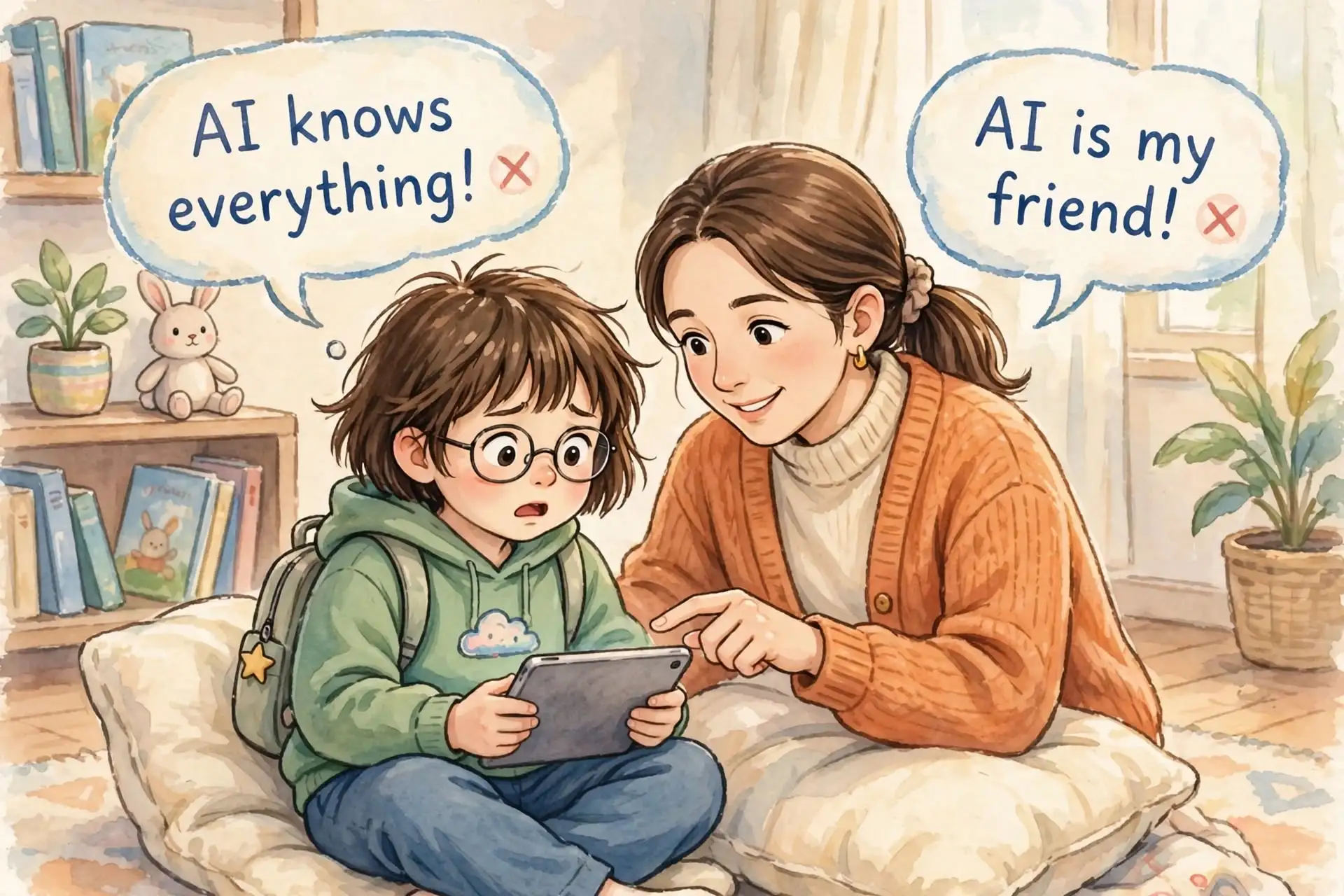
“Alexa knows everything.”
“The robot is my friend.”
“If the tablet says it, it must be true.”
If your child has ever said something like this, they are not alone. Children worldwide are forming ideas about artificial intelligence—and many of those ideas are not true.
Research shows that children develop misconceptions about AI based on what they see in everyday technology and media. They assume AI is human-like, infallible, or even magical. These assumptions are understandable—AI is designed to feel seamless, helpful, and often conversational. But without guidance, these myths can stick.
This post busts the top five myths children believe about AI—and gives you simple, practical ways to correct them.
Myth #1: “AI Knows Everything”
Many children assume that AI has perfect, unlimited knowledge. When a voice assistant answers a question or a streaming service recommends a show, children often believe the AI is drawing from a complete and flawless understanding of the world.
Why this myth is wrong: AI does not know anything in the way humans do. It predicts patterns based on data it has been trained on. It can be wrong, outdated, or biased. AI generates responses based on probabilities, not facts.
A 2024 study on children’s perceptions of AI found that misconceptions about AI capabilities, risks, and benefits abound, underlining the importance of early education on the subject. Another study found that 72% of children equated AI with a search application, blurring the line between probabilistic AI-generated responses and verified online information.
How to correct it: Show your child examples where AI gets things wrong. Compare AI answers with trusted sources like books or verified websites. Say: “AI is like a helpful guesser — it uses patterns to predict answers, but it doesn’t always get it right. That’s why we check.”
Myth #2: “AI Thinks Like a Human”
Because AI systems sound conversational and can respond to questions in natural language, children often believe they think, feel, or understand like a person. This is called anthropomorphism — attributing human characteristics to non-human entities.
Why this myth is wrong: AI does not think, feel, or have experiences. It generates patterns based on statistical models. It has no consciousness, no emotions, and no understanding of the words it produces.
Research has identified anthropomorphic AI as one of the most common misconceptions among children. A study of Finnish 5th and 6th graders found that children conceptualized AI as a human-like entity — a “vernacular, non-scientific, and conceptual misconception”. Similarly, a study of Cypriot children found that misconceptions like anthropomorphic AI were widespread.
How to correct it: Explain that AI does not feel or understand. Use simple language: “The smart helper doesn’t think like we do. It follows instructions that people gave it. It doesn’t have feelings — it just follows patterns.” Compare it to a toaster or a washing machine: helpful, but not alive.
Myth #3: “If AI Says It, It Must Be True”
Children often trust AI’s confident tone and assume its answers are always correct. This is particularly concerning because AI systems can generate plausible-sounding but completely incorrect information—sometimes called “hallucinations.”
Why this myth is wrong: AI can produce inaccurate, incomplete, or biased content. It does not have a way to verify its own outputs. As one expert put it, generative AI can even “talk nonsense with a straight face”.
A study using a tangible storytelling tool called Creat’AI found that initially, many children assumed that AI always provided correct answers, reflecting the common misconception that AI is infallible. However, after just two sessions where they saw AI make mistakes, a significant number of children revised their views, recognising that AI can generate incorrect or incomplete content.
How to correct it: Teach your child to verify AI answers using other sources. Ask questions like: “How do we know this is true?” or “Let’s check that together.” Model healthy skepticism. Say: “AI can be helpful, but we always double-check what it tells us.”
Myth #4: “AI Can Replace Learning — I Don’t Need to Try”
Some children believe that AI should do the work for them—especially writing, summarizing, or solving problems. This can lead to what experts call “cognitive off-loading”—using an external aid to avoid mental effort.
Why this myth is wrong: AI is a tool, not a substitute for thinking. While it can help organize ideas or explain concepts, it cannot replace the deep learning that comes from practice, struggle, and discovery.
There are also concerns that without adequate AI literacy, AI could disrupt the way a child learns to think and how they learn to read. Some experts worry that over-reliance on AI could potentially restrict critical thinking.
How to correct it: Reinforce a simple rule: “AI helps you start—you finish.” Use AI as a brainstorming partner, not a ghostwriter. Encourage your child to think through problems first, then use AI to check or expand their ideas. Celebrate the effort of thinking, not just the speed of getting an answer.
Myth #5: “AI Is My Friend”
Because AI systems can be conversational and responsive, some children start treating them like emotional companions. They may share personal information, develop one-way attachments, or trust AI with feelings and secrets.
Why this myth is wrong: AI is not a friend. It does not have emotions, loyalty, or genuine care. As one expert warned, “One-way friendships with AI lack the fulfilment of real relationships”. Children’s input in AI interactions is ultimately valueless to the AI itself — it is just data.
This is a major safety risk. Children may share personal information without understanding the consequences, or they may turn to AI for emotional support instead of real human connections. As UNICEF has noted in its Guidance on AI and Children, protecting children’s data and privacy is a fundamental requirement for child-centred AI.
How to correct it: Make a clear distinction: “AI is a tool, not a friend. It doesn’t have feelings. It doesn’t care about you the way people do.” Encourage your child to talk to real people about their feelings. Set clear boundaries about what information is safe to share with AI and what should stay private.
Summary Table
| Myth | The Truth | What to Say |
| “AI knows everything” | AI predicts patterns — it can be wrong | “AI is a helpful guesser. Let’s check if it’s right.” |
| “AI thinks like a human” | AI doesn’t think or feel — it follows patterns | “It doesn’t think like us. It follows instructions.” |
| “If AI says it, it’s true” | AI can generate incorrect information | “Let’s double-check that together.” |
| “AI can replace learning” | AI is a tool, not a substitute for thinking | “AI helps you start — you finish.” |
| “AI is my friend” | AI is not a friend — it doesn’t have feelings | “AI is a tool, not a friend. Talk to people about feelings.” |
Practical Takeaways
Here is what parents can do to help children develop accurate, healthy understandings of AI:
- Name the myths. When your child says something like “AI knows everything,” gently correct it. Use it as a teaching moment.
- Show AI making mistakes. Use examples where AI gets things wrong. This builds healthy skepticism and critical thinking.
- Model verification. When you use AI, say out loud: “Let me check that” or “I wonder if that’s true.” Show your child that you don’t trust AI blindly.
- Distinguish AI from humans. Use clear language: “AI doesn’t feel. It doesn’t understand. It follows patterns.” Repeat this often.
- Set boundaries. Talk to your child about what information is safe to share with AI and what should stay private. Remind them that AI is not a friend.
- Read stories together. Our Tech Tales series introduces AI vocabulary through gentle, engaging stories about Leo and Pip the Smart Helper. Each story is free, ad‑free, and designed to be enjoyed with a grown‑up nearby.
- Remember the goal. AI literacy is not about making children afraid of technology. It is about helping them understand it clearly, use it wisely, and question it critically.
A Positive Conclusion
Children are growing up in a world where AI is everywhere. They are forming ideas about it—some accurate, some not. Without guidance, these misconceptions can stick, shaping how they understand and use technology for years to come.
But there is good news. You do not need to be a computer scientist to correct these myths. You just need to notice them, name them, and gently guide your child toward a more accurate understanding.
UNESCO reminds us that the goal is to prepare young people to be “responsible users and co-creators of AI”. The OECD defines AI literacy as a set of knowledge, skills, and attitudes that equips learners to understand how AI systems work, critically evaluate their outputs, and use them ethically and creatively. UNICEF reminds us that AI should work in the best interests of children everywhere.
These goals are achievable. They begin with a single conversation — and with busting the myths that stand in the way.
What About You?
Has your child ever said something about AI that made you pause? What myths have you noticed — and how did you respond? Share your experience in the comments — we would love to hear how families are navigating these conversations.
About the Authors
Dr. Shaheen Pasha — Retired Professor of Special Education. Ph.D., University of Southampton, UK. Former Chairperson, Department of Special Education, University of Education, Lahore. 35+ research papers, 2 books.
Dr. M. A. Pasha — Retired Professor of Computer Science. Ph.D. in Artificial Intelligence, University of Southampton, UK (1996). Research: AI, Human-Computer Interaction, Computational Thinking. 30+ research papers, 2 books.
Their mission: 70 years of combined academic wisdom, united to foster AI pre‑literacy in young children.
References
- Kasinidou, M., Kleanthous, S., & Otterbacher, J. (2024). “AI is a robot that knows many things”: Cypriot children’s perception of AI. Interaction Design and Children (IDC ’24).
- Mertala, P., & Fagerlund, J. (2024). Finnish 5th and 6th graders’ misconceptions about artificial intelligence. International Journal of Child-Computer Interaction, 39.
- Chang, X., Yan, Z., & Wong, G. K. W. (2026). Young children’s understanding of artificial intelligence: A draw-a-picture analysis. British Journal of Educational Technology, 57(1).
- LittleLit. (2025). The Biggest Myths Kids Believe About AI — and How to Correct Them.
- UNESCO. (2024). AI Competency Framework for Students.
- OECD. (2025). Empowering Learners for the Age of AI: An AI Literacy Framework for Primary and Secondary Education.
- UNICEF. (2025). Guidance on AI and Children (Version 3.0).