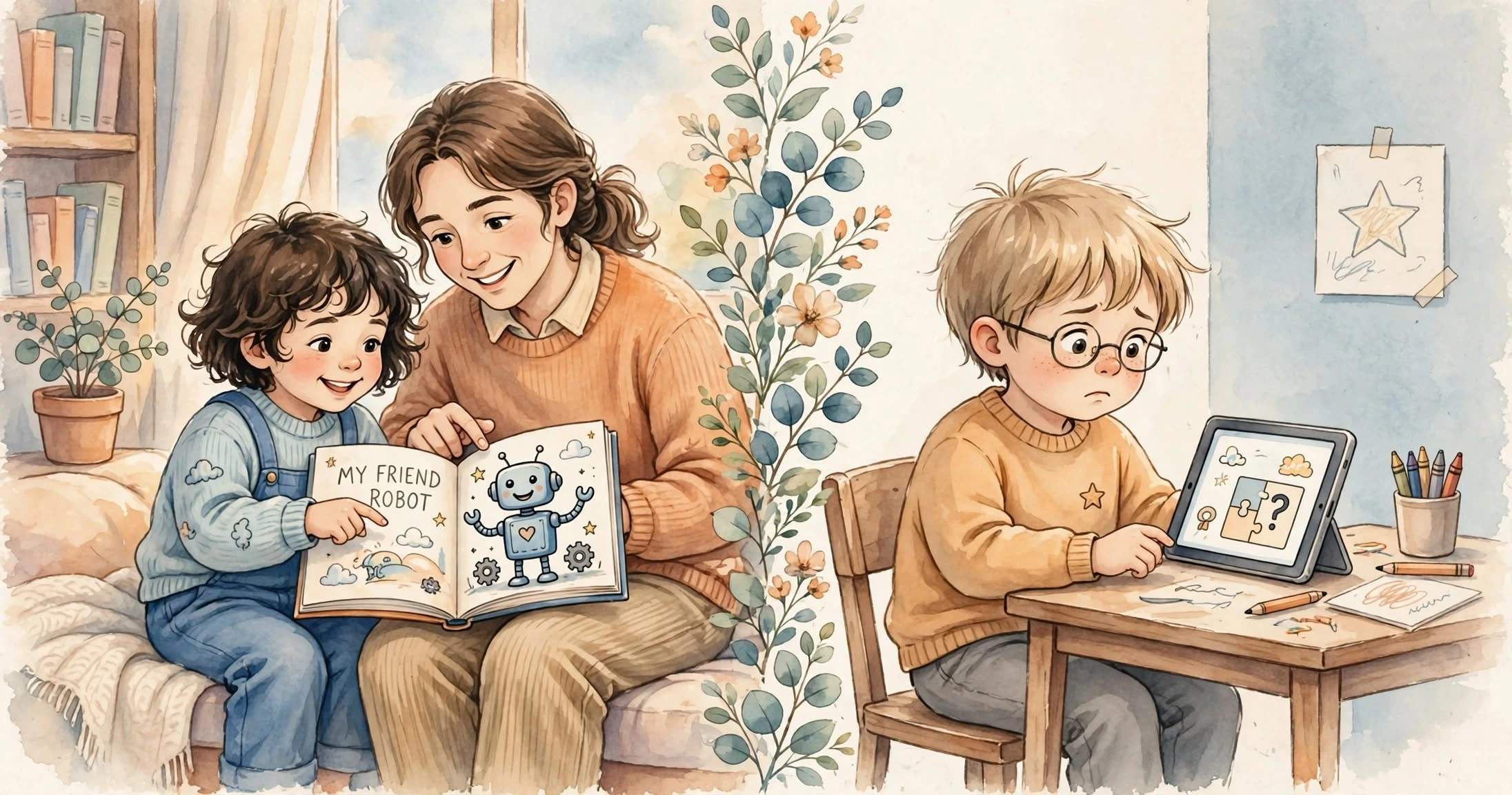
Imagine two children, both five years old.
One grows up in a home where parents talk about technology. They explain that the voice in the smart speaker follows instructions. They ask questions about why the tablet recommends certain shows. They read stories together about smart helpers and friendly robots.
The other child uses the same devices. They ask the same questions to the smart speaker. They watch the same shows. But no one ever explains what is happening behind the screen. No one gives them the words to understand. No one helps them wonder.
Both children are using artificial intelligence every day. But only one is learning to understand it.
This is the AI literacy gap. And it is already shaping the futures of millions of children around the world.
The consequences are not distant—they are unfolding now, in homes, in classrooms, and in the opportunities that will be available to our children in the years ahead.
The Problem
Artificial intelligence is becoming increasingly ubiquitous in young children’s environments. Children interact with voice assistants, smart toys, recommendation algorithms, and conversational agents from a very young age. Yet most education systems are not preparing them to engage deeply with AI or to understand how to use it safely.
The OECD’s Director for Education and Skills, Andreas Schleicher, has warned that this gap “could leave future generations underprepared for the challenges and opportunities of an even more rapidly changing digital economy and world”.
Research is now revealing the scale of the problem. A 2025 study published in Early Childhood Education Journal identified three critical gaps:
- An “AI “divide”—unequal access to and use of AI for learning between socioeconomically advantaged and disadvantaged children.
- Accessibility and opportunity gaps—disparities in AI literacy acquisition between these same groups.
- An ethical gap — children using AI without understanding its risks, biases, or limitations.
A systematic review of early childhood AI literacy research published in 2026 identified deeper structural flaws. The review found that the field suffers from a “Tool-Driven” bias, where educational goals are often defined by the capabilities of commercial hardware rather than by children’s actual developmental needs. This has led to what researchers call a “ripple effect”—the lack of child-specific theory leads to superficial assessments, which in turn fail to produce the robust evidence needed to win broad social support.
Perhaps most concerning is what happens when children are left to form their own understanding of AI without guidance. A 2025 study exploring young children’s understanding of AI found that children as young as three to six years old already have preconceptions about AI. They understand AI through concretization and anthropomorphization — they view it as an assistant or companion, show awareness of risks, and display strong imagination about what AI is and what it can do.
But without guidance, these preconceptions can become misconceptions. Children may believe that AI is a person, that it has feelings, or that it is always right. They may trust recommendations without question. They may share personal information without understanding the consequences.
The problem is not that children are using technology too early. The problem is that they are using it without understanding it — and without the vocabulary, the concepts, or the critical awareness to make sense of these interactions.
UNICEF has observed that children are adopting AI technologies more than three times faster than adults. Yet guidance on how AI policies and systems can uphold children’s rights remains scarce. This means that children are interacting with AI systems at a scale and speed that far exceeds the safeguards designed to protect them.
The stakes are high. As one analysis warned, “lack of AI literacy risks not only economic stagnation, but societal instability”. The nations that lead in AI will dominate in economic productivity, cybersecurity, and innovation. And within nations, the children who develop AI literacy will have opportunities that others will not.
The Solution / Argument
The solution is not to shield children from AI. That is neither realistic nor desirable. AI is not going away, and it offers enormous opportunities for learning, creativity, and connection.
The solution is to close the AI literacy gap—starting in early childhood.
This is precisely what AI pre‑literacy offers. It is the foundational stage — typically between the ages of 2 and 7 — where the goal is not to teach coding or technical concepts, but to build awareness, safe habits, critical thinking, and a healthy relationship with intelligent technologies.
The world’s leading international organisations agree that this matters.
UNESCO, in its AI Competency Framework for Students launched during Digital Learning Week 2024, outlines twelve competencies across four dimensions:
- A human‑centred mindset — encouraging students to understand and assert their agency in relation to AI
- Ethics of AI—teaching responsible use, ethics-by-design and safe practices
- AI techniques and applications—providing foundational AI knowledge and skills
- AI system design—fostering problem-solving, creativity and design thinking
The framework aims to guide countries in supporting students to understand the potential, as well as risks, of AI in order to engage with it in a safe, ethical and responsible manner.
UNICEF, through its Guidance on AI and Children (Version 3.0), offers ten requirements for child-centred AI, including ensuring safety for children, protecting children’s data and privacy, ensuring non-discrimination and fairness, and preparing and skilling children for present and future developments in AI. UNICEF emphasises that AI systems should be designed with maximum safety and transparency, so all children have a chance to be protected while benefiting from opportunities.
The OECD and the European Commission, in May 2025, jointly launched a draft AI Literacy Framework for primary and secondary education. The framework outlines the knowledge, skills and attitudes that will adequately prepare students in primary and secondary education. It will provide the foundation for the first assessment of AI Literacy in the OECD’s Programme for International Student Assessment (PISA) in 2029.
These frameworks are not abstract documents. They are a clear signal from the world’s leading education and child-rights organisations that AI literacy is no longer optional. It is essential. And it must begin early.
Yet research shows that AI literacy in early childhood education (ages 3-8) remains an underdeveloped research area, compared to the rapidly expanding body of work for adults and older students. Significant challenges remain, including limited AI knowledge among caregivers and educators, and ongoing concerns about overuse.
This is the gap that AI pre‑literacy fills—and it must be filled now.
Evidence / Examples
The consequences of the AI literacy gap are already visible in research.
The AI divide is real and growing. A study of children across four countries (Brazil, Kenya, Thailand and the United Kingdom) found that the gaps between children’s use and critical understanding of AI were substantial. Many children needed teacher and parent guidance that they were not receiving. The study warned that “AI is likely to amplify literacy gaps, not close them”.
Children form misconceptions without guidance. A 2025 study on young children’s understanding of AI found that everyday technology and media act as the two main sources of young children’s understanding of AI. In other words, children are forming their ideas about AI not from school or from parents, but from the devices and content they encounter daily — often without guidance.
The ethical gap is a serious concern. Research has identified that children are exposed to AI tools without clear guidelines for ethical, safe, and responsible use. Without guidance, children may not understand the biases embedded in AI systems, the privacy implications of sharing data, or the limitations of AI-generated content.
Critical thinking can be compromised. There are concerns that without adequate AI literacy, AI could disrupt the way a child learns to think and how they learn to read. Some experts worry that AI could potentially restrict critical thinking.
The gap could have lifelong consequences. As one analysis warned, children who do not develop AI literacy may be left behind, losing “capacity and agency”. Some may become “AI illiterate”, facing the risk of losing social agency. If a “huge divide” emerges between children, it could perpetuate inequality for generations.
Investment in early AI literacy pays off. Research has demonstrated that young children are capable of learning basic AI concepts when they are introduced in age-appropriate ways. An intervention study in Hong Kong found that an eight-week AI literacy program significantly improved young children’s AI literacy and AI-related creativity. Other research has shown that introducing AI teaching aids or interactive activities in early childhood can promote children’s cognitive development, creative thinking, social cooperation, and problem-solving abilities.
The research is clear: children who develop AI literacy early will have advantages that others will not. And children who do not will face challenges that others will not.
Practical Takeaways
Here is what parents can do today to help close the AI literacy gap for their children:
- Start the conversation. Talk to your child about the AI they encounter every day. When they use a voice assistant, ask: “What do you think is happening when you ask that question?” When they watch a recommended show, ask: “Why do you think the tablet suggested that?”
- Build vocabulary. Words like smart helper, voice command, sensor, battery, correction, touchscreen, algorithm, and cloud are not too complex for a young child — especially when they are introduced through stories and everyday experiences.
- Make it a shared experience. The World Health Organization and the American Academy of Pediatrics both recommend that screen time for young children be shared with a trusted adult. Use that time as an opportunity for conversation, not just consumption.
- Read stories together. Our Tech Tales series introduces AI vocabulary through gentle, engaging stories about Leo and Pip the Smart Helper. Each story is free, ad‑free, and designed to be enjoyed with a grown‑up nearby.
- Model curiosity. You do not need to be a computer scientist. When your child asks a question you cannot answer, explore it together. Say: “That’s a great question. Let’s find out together.” This models the curiosity and critical thinking that AI literacy requires.
- Advocate for AI literacy in your child’s school. Ask teachers and school leaders what they are doing to prepare children for an AI-driven world. Share resources like the UNESCO and OECD frameworks with them.
- Remember the goal. AI pre‑literacy is not about turning your child into a programmer. It is about helping them grow up comfortable, confident, and critical about the technologies that will shape their world.
A Positive Conclusion
The AI literacy gap is real. It is growing. And it has serious consequences for children who are left without guidance.
But there is also good news. The gap can be closed. It starts with a single conversation. It starts with a single story. It starts with a single word.
Every child deserves to grow up understanding the technologies that will shape their world. Every child deserves the vocabulary to ask questions, the curiosity to explore, and the critical thinking to navigate an AI-driven future with confidence.
UNESCO reminds us that the goal is to prepare young people to be “responsible users and co-creators of AI”. UNICEF reminds us that AI should work in the best interests of children everywhere. The OECD reminds us that AI literacy is essential for future generations.
These are not distant ideals. They are achievable goals. And they begin not with a keyboard, but with a question. Not with code, but with a story. Not with a screen alone, but with a grown‑up nearby.
The AI literacy gap does not have to define our children’s future. We can close it — starting today.
What About You?
Have you noticed the AI literacy gap in your own child’s life? What questions have they asked about the technology they use, and how have you responded? Share your experience in the comments — we would love to hear how families are navigating these conversations.
References
- Chen, J. J., & Delaney, V. (2025). Leveraging AI to Enhance Children’s Learning: Anchoring Policy and Practice in Equity, AI Literacy, and Ethics. Early Childhood Education Journal, 54, 2655–2665.
- Wang, R., Li, X., & Ng, D. T. K. (2026). Framing early childhood AI literacy: What did the literature review tell us? AI, Brain and Child.
- UNESCO. (2024). AI Competency Framework for Students. UNESCO Digital Library.
- OECD & European Commission. (2025). Empowering Learners for the Age of AI: An AI Literacy Framework for Primary and Secondary Education (Review Draft).
- UNICEF. (2025). Guidance on AI and Children (Version 3.0). UNICEF Innocenti.
- Yang, W., et al. (2024). Artificial Intelligence (AI) Literacy in Early Childhood Education: An Intervention Study in Hong Kong. Interactive Learning Environments.
- Luo, W., He, H., Gao, M., & Li, H. (2024). Safety, Identity, Attitude, Cognition, and Capability: The ‘SIACC’ Framework of Early Childhood AI Literacy. Education Sciences, 14(8), 871.
- UNESCO AI Competency Framework for Students
- OECD AI Literacy Framework (Draft)
- UNICEF Guidance on AI and Children
About the Authors
Dr. Shaheen Pasha — Retired Professor of Special Education. Ph.D., University of Southampton, UK. Former Chairperson, Department of Special Education, University of Education, Lahore. 35+ research papers, 2 books.
Dr. M. A. Pasha — Retired Professor of Computer Science. Ph.D. in Artificial Intelligence, University of Southampton, UK (1996). Research: AI, Human-Computer Interaction, Computational Thinking. 30+ research papers, 2 books.
Their mission: 70 years of combined academic wisdom, united to foster AI pre‑literacy in young children.