In our previous article, we proposed AI pre-literacy as a developmental construct preceding formal AI literacy.
This article takes the next step. Rather than repeating the definition, we examine a question within the existing AI-literacy literature:
What developmental capacities must exist before AI literacy itself can begin?
AI Literacy Has Changed the Conversation
AI literacy has developed rapidly. Long and Magerko (2020) identified competencies required to understand, interact with, and critically evaluate AI. Ng et al. (2021) subsequently synthesized the literature around four broad dimensions: understanding AI, using and applying AI, evaluating and creating with AI, and addressing ethical issues.
This work has been important because it moves AI education beyond simply teaching people how to operate AI tools.
But these models are primarily concerned with competency.
And that raises another question.
Competency Is Not the Beginning
AI-literacy frameworks generally ask what a learner should know, understand, use, evaluate, create, or judge.
These are important questions.
But a young child first needs other capacities.
A child cannot meaningfully question an AI system without some ability to question. A child cannot consider whether an AI decision is fair without an emerging understanding of fairness. A child cannot reflect on technological agency without some developing concept of agency itself.
Language, imagination, curiosity, pattern recognition, social understanding, reflection, and emerging ethical awareness therefore matter before formal AI competencies can be fully developed.
These capacities are not AI literacy.
They may be foundations for later AI literacy.
What Does Early Childhood Research Tell Us?
Research demonstrates that young children can engage with AI-related technologies through developmentally appropriate experiences such as robotics, play, and guided inquiry (Kewalramani et al., 2021; Su & Yang, 2024).
This is important.
It means that the question is not whether young children can encounter AI.
They clearly can.
The more interesting question is:
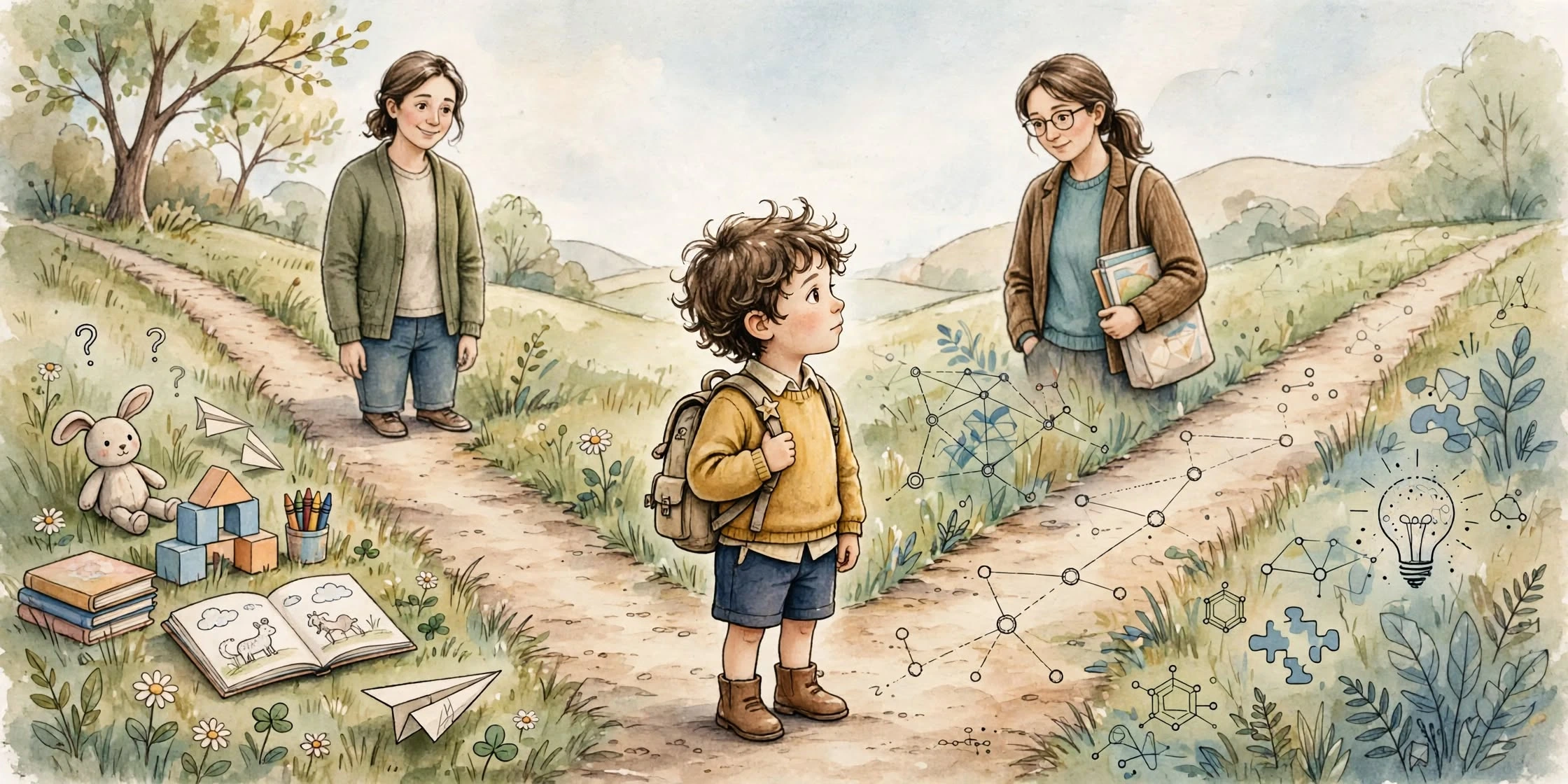
What happens between a child’s first encounter with AI and the later acquisition of formal AI-literacy competencies?
Su et al. (2023) identify significant challenges in developing AI literacy in early childhood, including issues of curriculum, pedagogy, and teacher preparation.
The research therefore provides important pieces of the puzzle—but the developmental interval between encounter and competency deserves further conceptual and empirical attention.
A Different Question
AI literacy asks:
What competencies enable a person to understand and engage with AI?
AI pre-literacy asks:
What developmental foundations enable a child eventually to acquire those competencies?
The distinction may appear small.
Educationally, it is not.
It shifts the focus from competency acquisition to developmental preparation.
For parents, this distinction is particularly relevant. A parent of a four-year-old may not need to teach algorithms or machine learning. The more immediate opportunity may be helping a child learn to question, describe, imagine, compare, predict, recognize patterns, consider choices, and think about fairness and agency while interacting with increasingly intelligent technologies.
A Gap Worth Investigating
The existing AI-literacy literature should not be dismissed. It has established an important foundation for understanding what AI-literate learners may need to know and do.
Our proposal is narrower.
There may be a developmental layer preceding formal AI literacy that requires its own conceptual and empirical examination.
This is the space in which we propose AI pre-literacy.
But we should be precise: AI pre-literacy is currently a proposed construct, not an empirically established developmental stage.
It therefore requires research capable of distinguishing it from general early childhood development, digital literacy, technology awareness, and formal AI literacy.
That research is now an important next step.
The Question Ahead
International organizations increasingly emphasize AI literacy, human-centredness, ethics, critical thinking, agency, safety, and children’s rights (UNESCO, 2021, 2024; UNICEF, 2025).
The next question may therefore be developmental:
What foundations should precede AI literacy when the learner is a young child?
AI pre-literacy is our proposed answer.
Whether it withstands empirical investigation is a question for future research.
Key Takeaway
AI literacy identifies important competencies. AI pre-literacy asks what developmental foundations may make those competencies possible.
What About You?
Do current AI-literacy frameworks adequately address the developmental needs of children under seven?
Parents, teachers, educators, and researchers: we would value your perspective.
References
Kewalramani, S., Kidman, G., & Palaiologou, I. (2021). Using artificial intelligence (AI)-interfaced robotic toys in early childhood settings: A case for children’s inquiry literacy. European Early Childhood Education Research Journal, 29(5), 652–668.
Long, D., & Magerko, B. (2020). What is AI literacy? Competencies and design considerations. Proceedings of the 2020 CHI Conference on Human Factors in Computing Systems, 1–16.
Ng, D. T. K., Leung, J. K. L., Chu, S. K. W., & Qiao, M. S. (2021). Conceptualizing AI literacy: An exploratory review. Computers and Education: Artificial Intelligence, 2, 100041.
Su, J., Ng, D. T. K., & Chu, S. K. W. (2023). Artificial intelligence (AI) literacy in early childhood education: The challenges and opportunities. Computers and Education: Artificial Intelligence, 4, 100124.
Su, J., & Yang, W. (2024). AI literacy curriculum and its relation to children’s perceptions of robots and attitudes towards engineering and science: An intervention study in early childhood education. Journal of Computer Assisted Learning, 40(1), 241–253.
UNESCO. (2021). Recommendation on the ethics of artificial intelligence. UNESCO.
UNESCO. (2024). AI competency framework for students. UNESCO.
UNICEF. (2025). Guidance on AI and children: Version 3.0—Recommendations for AI policies and systems that uphold child rights. UNICEF Office of Strategy and Evidence Innocenti.
About the Authors
Prof. Dr. Shaheen Pasha & Prof. Dr. Muhammad Anwar-ur-Rehman Pasha
Authors and education researchers working on children’s development, education, and the implications of artificial intelligence for the emerging AI-driven society.